Hopper Screw Conveyors: Solving Feed and Discharge Challenges in Bulk Handling
Bulk material handling requires more than just transferring the material from one place to another. Prior to being fed to a processing machine, the material has to be gathered, stored, metered, and discharged. It is then that the hopper screw conveyor may come in handy.
Through the integration of the hopper with screw conveyors, bulk materials can be fed from the storage or gathering area into the next equipment in a controlled fashion. Such a combination of systems may come in handy for places dealing with powders, granulars, aggregate materials, agricultural goods, chemicals, and others.
What Is a Hopper Screw Conveyor?
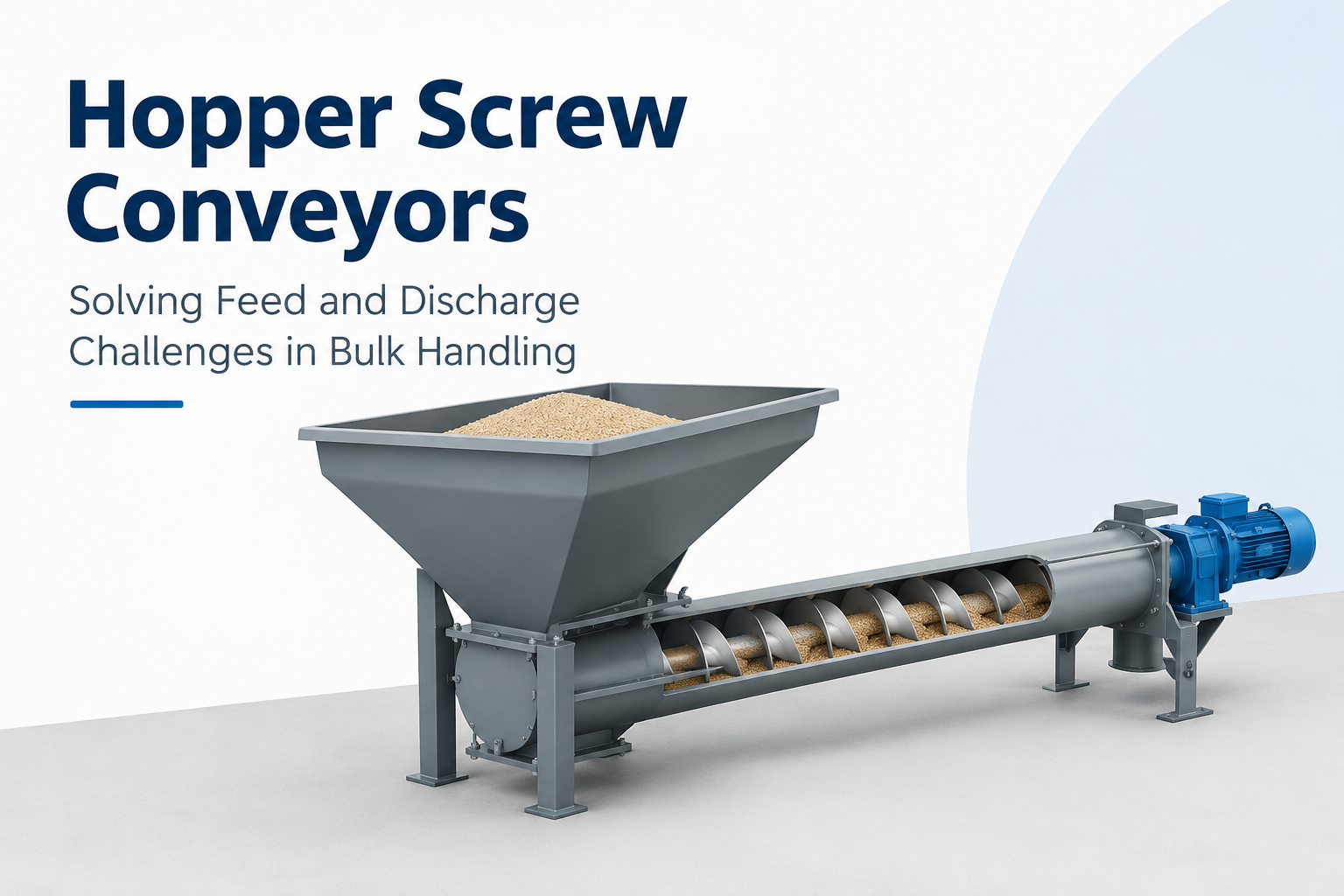
In a hopper screw conveyor, the conveying process takes place through a combination of the material-holding hopper and a screw mechanism that rotates. Materials are fed into the hopper, from where they are conveyed by the screw to the discharge end.
The material movement is facilitated by the rotation of the screw, while the hopper temporarily stores the material. The system can be set up either for material transport or feeding depending on the specific application of the system.
There are many ways in which a hopper screw conveyor system can be set up to accommodate the different applications. The different factors include length, diameter, orientation, material of construction, and others.
Why Hoppers and Screw Conveyors Work Well Together

Bulk materials do not always flow consistently when discharged from storage equipment. Powders may bridge, cohesive materials may resist flow, and granular products can discharge unevenly.
A properly designed hopper helps collect and direct material toward the conveying screw. The screw then provides controlled movement away from the hopper and toward the next stage of the process.
This combination can help facilities:
- Control material discharge
- Provide consistent feeding
- Reduce uncontrolled material flow
- Move material horizontally or on an incline
- Connect storage equipment with downstream processes
- Integrate feeding and conveying into one system
The exact configuration should be based on the material's characteristics and the desired throughput.
Using a Feed Screw Conveyor for Controlled Material Flow
The feed screw conveyor is the ideal choice when material needs to be fed to another process at a controlled pace.
While a conveyor's main purpose is moving, a feeder should take into account how the material will enter the screw and how consistently it will be discharged from it. The screw itself, the pitch, its speed, the entrance of the screw, and hopper design may influence feeding.
Variable-pitch screw conveyors can be applied in cases when it is necessary to gently feed material into the conveyor. The exact design should depend on material and feed rate.
If the screw conveyor is mounted beneath the hopper, then it will create a convenient connection between storage and mixing, crushing, drying, screening, or other equipment.
The Role of a Spiral Screw Conveyor
In a spiral screw conveyor, the screw flights turn to move material along the trough or tube.
The spiral screw conveyor is highly adaptable since it is easy to design for various material flows, capacity requirements, distances, and setups.
The screw conveyor has many applications depending on what needs to be done, whether it's bulk material transportation, feeding, metering, mixing, or any other process.
In applications that need dust containment, the fact that the screw conveyor is enclosed helps in achieving this.
With a hopper, the spiral screw allows for the controlled movement of the materials from storage to further processing stages.
Solving Common Hopper Discharge Problems
Material flow is one of the most challenging areas in bulk handling systems. The hopper could successfully contain material yet face challenges at the point of egress from the bin.
Some of the problems that might arise may include bridging, rat holing, arching, surging, and non-uniform flow. This problem may be caused by the nature of material being handled, the shape of the hopper, moisture content, particle size, bulk density, and material flowability.
The use of screw conveyors could assist in the creation of movement at the discharge point of the hopper. Yet, this equipment and the hopper must be treated as one rather than separately.
Knowing the material is essential. It would need to be taken into consideration whether the material is granular or cohesive.
Important Design Considerations
When selecting or designing a hopper screw conveyor, several factors should be evaluated.
Material Characteristics
Bulk density, particle size, moisture content, abrasiveness, temperature, cohesiveness, and flowability can all impact the design of a conveyor system.
Capacity Required
The system must be designed to accommodate the required capacity. Both the hopper and the screw must be able to accommodate the desired flow rate.
Screw Design
Screw diameter, pitch, speed, flight configuration, and shaft design may all impact conveying and feed performance.
Hopper Design
The hopper must ensure efficient conveyance of material to the inlet of the screw. Its shape and dimensions must be suitable for the application.
Materials of Construction
Carbon steel, stainless steel, abrasion-resistant materials, liners, and special components may all be considered for the system depending on the material.
Component Accessibility
Access for inspection and servicing of components such as bearings, seals, drive systems, and others is essential.
Benefits of Custom Screw Conveyor Solutions
However, it is not always possible to use a regular conveyor in each case. Existing machinery, lack of room, special properties of material, and special feeding needs might require a specially designed solution.
A custom screw conveyor can be developed according to the particularities of the application, which include capacity, type of material, configuration, discharge needs, among others. It might include customizing such aspects as hopper size, screw setup, feed and discharge setup, materials used, and more.
In cases when the problem is complicated, cooperation with a professional conveyor maker can be useful because of the integration of the hopper and screw into one handling system.
Applications for Hopper Screw Conveyors
Hopper screw conveyors have many possible uses within the industries that employ such bulk material handling systems. Possible uses might be found in agriculture, food processing, chemical processing, sewage treatment, minerals processing, biomass, and industrial manufacture.
It is possible to use them for conveying materials from storage silos, hoppers, or collection bins into subsequent machinery.
There are different systems for different types of material and processes. For example, a screw conveyor for abrasive aggregates would need a different design from one used for dry foodstuffs.
Conclusion
A hopper screwconveyor can provide an efficient solution for facilities that need reliable material feeding and controlled discharge. By combining a storage hopper with a screw conveying mechanism, the system can help regulate material flow between storage and processing equipment.
Whether the application requires a feed screw conveyor for controlled metering or a spiral screw conveyor for dependable bulk material transportation, proper engineering is essential. Material properties, capacity, hopper geometry, screw configuration, construction materials, and maintenance requirements should all be considered before selecting equipment.
Conveyors Inc. provides screw conveyors and bulk material handling solutions designed for a wide range of industrial applications. For facilities facing challenging feed or discharge requirements, a properly engineered screw conveyor system can help improve material flow, support consistent production, and reduce handling problems.
Need a solution for a difficult feeding or discharge application? Start with the material characteristics, required capacity, and facility layout, then work with an experienced conveyor manufacturer to develop a system suited to the process.