Thermal Screw Conveyors: Cooling and Heating Bulk Material in One System
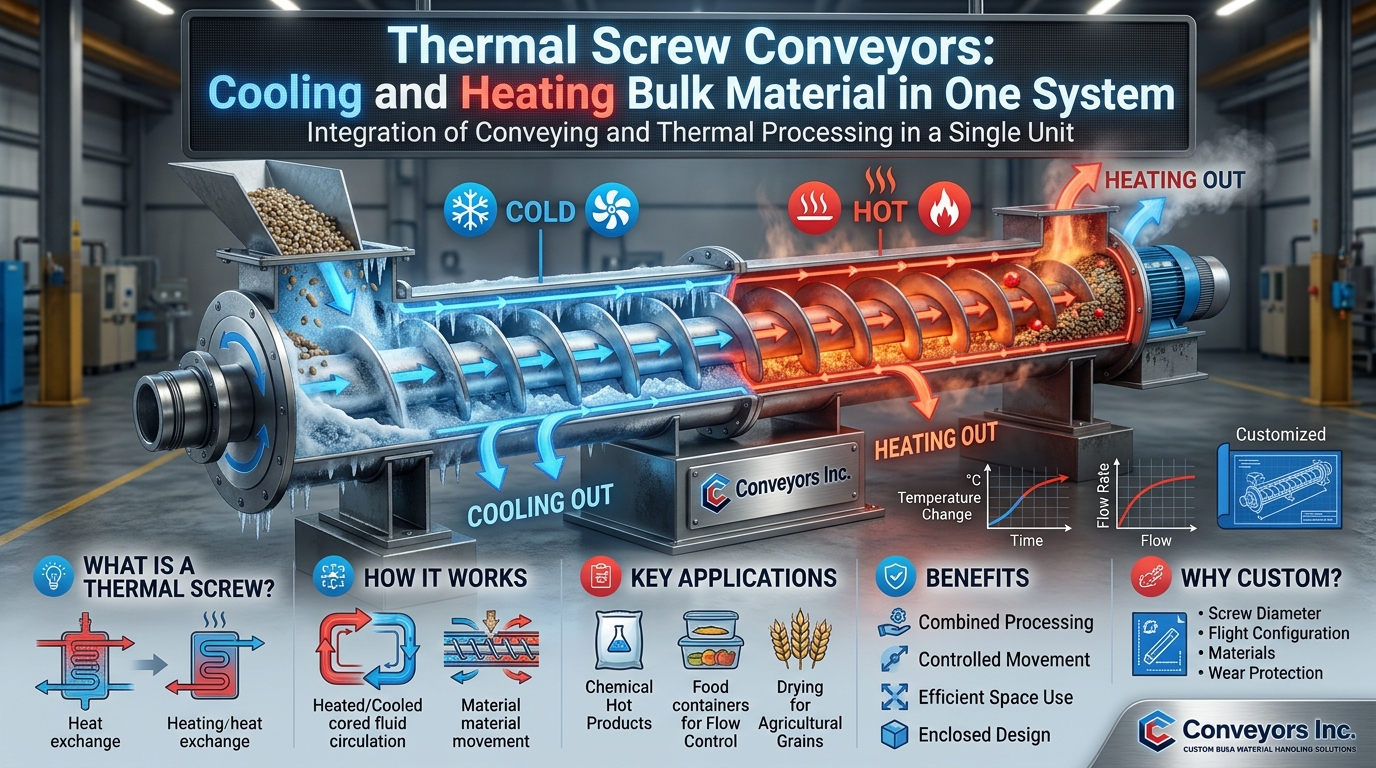
In bulk material conveying systems, there is not always just a need to move the material from one place to another. For many industries, there is also a need to either heat, cool, dry, or keep the material at a certain temperature while conveying it through the system. Thermal screw conveyors can be used to incorporate both conveying and heating/cooling processes in a single unit.
The integration of heat transfer into a screw conveyor system can allow manufacturers to reduce the need for additional processing equipment and convey the material in a controlled way. Thermal screw conveyors can be designed for use with materials that require heating or cooling.
Chemicals, food products, agricultural materials, minerals, and other bulk solids can be processed using thermal screw conveyors, and thus knowledge of the working principles of thermal screw conveyors can help understand whether such conveyors should be used.
What Is a Thermal Screw Conveyor?
A thermal screw conveyor refers to a screw conveyor system that facilitates heat exchange between the conveyor and the bulk material being conveyed along it. Depending on the requirements of the application, the conveyor can be designed to either heat or cool the material.
Heating/cooling elements can be integrated into the flights of the screw, the shaft, trough, or any other part of the conveyor. The heating/cooling media will then flow through these elements.
In such an arrangement, the process of conveying and thermal processing is done using one machine. In contrast, with traditional methods, the material has to be transferred from one machine to another.
How Does a Thermal Screw Work?
In essence, the fundamental concept behind thermal conveyor belts is rather simple: the bulk material moves along the conveyor while the heat is exchanged between the bulk material and the conveyor surface.
If we need to increase the temperature of the bulk material, a heated fluid can be circulated within the conveyor. In case we need to reduce the temperature of the bulk material, a cooling medium can be used.
The medium for heat transfer may be water, thermal oil, steam, air, etc.
The specific design depends on factors such as:
- Material characteristics
- Required temperature change
- Material throughput
- Residence time
- Operating temperature
- Moisture content
- Particle size
- Heat-transfer requirements
- Available space
These factors should be evaluated before selecting or designing the equipment.
Applications for Cooling Screw Conveyors
A cooling screw conveyor may be helpful if there is a situation where the product comes out from a process at a temperature that is too high for further handling, storage, packing, or processing.
This is because some materials might need cooling after drying, heating, chemical processing, or any other thermal process. Transporting the material by means of a thermal screw conveyor enables the process of cooling to take place continuously during transport.
Cooling may also help prepare material for further processing machinery. This is because cooling is done as part of transport without the need for an additional cooling process.
However, the efficiency of the process will depend on various factors such as material properties, temperature difference, surface area, residence time, and heat transfer equipment design.
Heating Bulk Materials During Conveying
The application of thermal screw conveyors is not restricted to the cooling function. The same conveyors can be designed to heat the material being conveyed as well.
The heating process might be necessary in order to ensure good flow properties, dehumidify the material, control process temperature, soften some material, or prepare material for a subsequent processing stage.
Conveying together with heating of material can result in a decrease in the number of processing stages. Thermal treatment is provided by means of the conveyor during its operation.
Benefits of a Thermal Screw Conveyor
One of the primary advantages of thermal screw technology is its ability to combine material handling and thermal processing.
Potential benefits include:
Combined Conveying and Thermal Processing
A thermal screw can perform two functions within one integrated piece of equipment. Material is transported while heat is added or removed.
Controlled Material Movement
Screw conveyors provide controlled movement of bulk solids. The conveyor's speed, pitch, diameter, and configuration can be selected based on the material and process requirements.
Efficient Use of Space
Combining conveying and thermal treatment can reduce the need for separate equipment and potentially simplify facility layouts.
Enclosed Material Handling
Screw conveyors can provide an enclosed conveying path, which can help contain dust and reduce exposure to the surrounding environment.
Customizable Design
Thermal screw conveyors can be engineered around specific material characteristics, temperatures, capacities, and space limitations.
Why a Custom Screw Conveyor May Be Necessary
Every thermal processing application has different requirements. A standard conveyor may not provide the necessary heat-transfer surface, residence time, capacity, or configuration.
A Custom Screw Conveyor can be designed around the specific process.
Custom design considerations may include screw diameter, conveyor length, flight configuration, shaft design, trough construction, inlet and discharge arrangement, thermal jacket configuration, insulation, and material of construction.
For example, a facility handling abrasive bulk solids may require different construction and wear protection than an application involving sensitive food products.
Customization also allows the conveyor to fit into existing production equipment and facility layouts.
Factors to Consider Before Selecting a Thermal Screw
Before purchasing thermal screw equipment, one needs to analyze the whole process.
To start with, material properties need to be identified. Bulk density, particle size, moisture content, flowability, abrasiveness, and temperature of the material can affect the conveyor design.
Secondly, it is necessary to define the required thermal capability of the equipment. How much heat will be necessary to apply or dissipate? At what temperatures does the process take place? How long does the material have to reach the necessary temperature?
Throughput and residence time are equally important. If the material moves too fast, it won’t have enough time to exchange heat.
In the end, it is necessary to keep in mind the maintenance requirements of the equipment.
Integrating Thermal Conveying into Your Process
This type of conveyor is thus a very suitable choice where there is a need for both material handling and thermal conditioning.
It must, however, be engineered properly. The design of the conveyor will have to be based on the material handled, the amount, the thermal needs, the space available, and the process itself.
Conveyors Inc. supplies screw conveyors and custom bulk material handling equipment for many industrial processes. Among its services are custom conveyor designs that are tailored to the material handling needs of the process.
Conclusion
However, a thermal screw conveyor will not only convey bulk material but also help in its cooling or heating in the course of conveyance. In cases where the temperature needs to be controlled, this type of solution can prove to be useful in integrating conveying and thermal treatment into one process.
If the need is to cool the material after it has been processed at elevated temperatures or heat it prior to further processing, then the appropriately designed cooling screw conveyor or heating design can play an important role in an efficient material handling setup.
In case the conventional equipment does not fit the specific application, then a Custom Screw Conveyor can be used to overcome the limitations of the materials, processes, and layouts involved.
For those who are planning to implement thermal conveyors, a comprehensive analysis of materials and processes involved is the most important step towards a successful implementation of thermal screw technology.