Vertical Screw Conveyors: Moving Bulk Material Straight Up Without Losing Efficiency
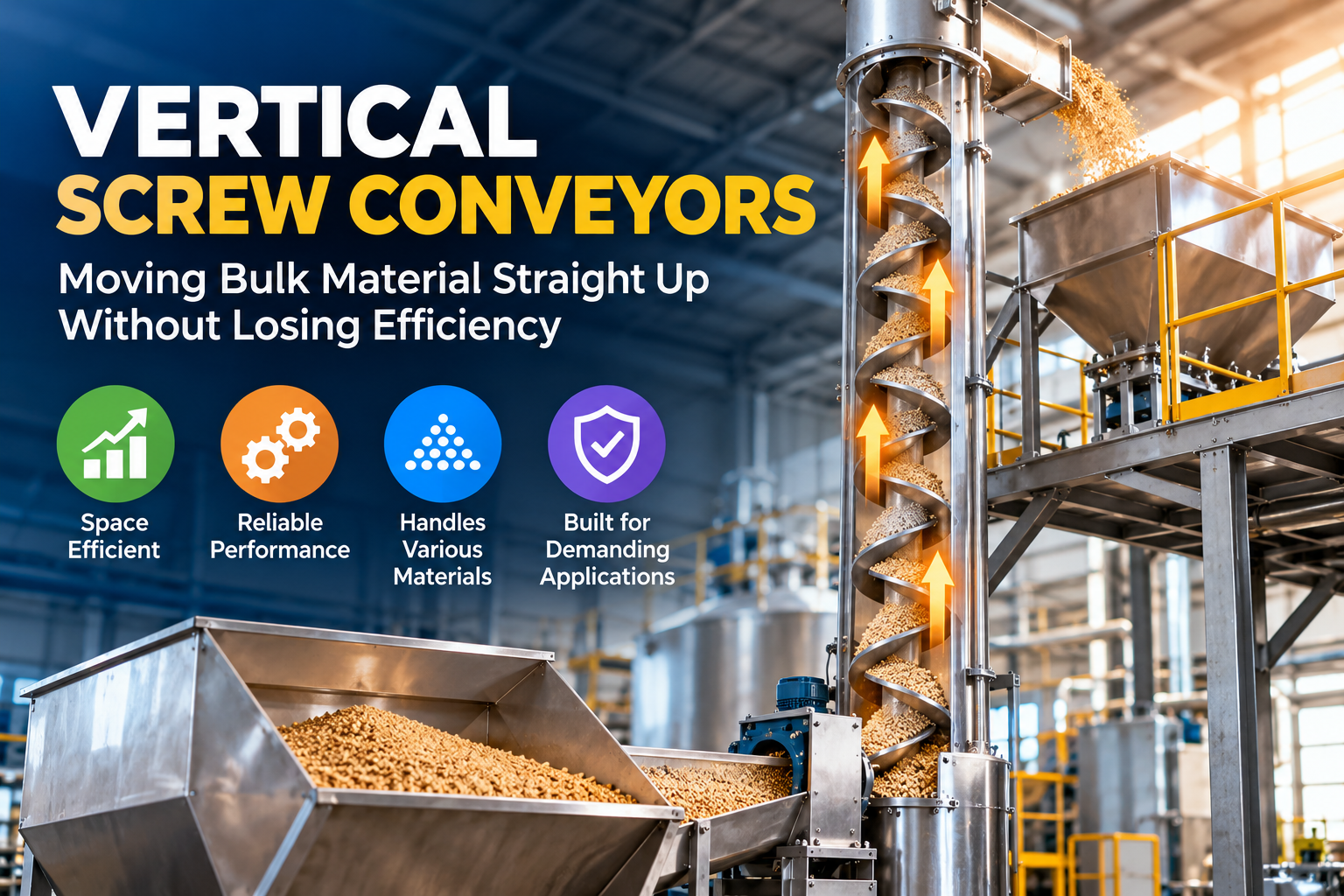
The transport of bulk material vertically poses a specific problem for producers. It is easy enough to convey the material horizontally, but to lift it through the facility, it takes a piece of equipment that will be able to operate against gravity and move at a constant speed without damaging the material being conveyed.
The Vertical Screw Conveyor offers a great way to vertically convey bulk material with a minimal consumption of floor space. The material is lifted by a screw installed vertically inside a pipe from a low level up to a high discharge level.
With the correct design, these conveyors allow for smooth material conveyance while being integrated into hopper, feeder, processing, storage, and other conveyor systems.
What Is a Vertical Screw Conveyor?
The Vertical Screw Conveyor is a mechanism that is used to lift bulk materials in an upward direction along a vertical or steep angle.
The main difference between a vertical screw conveyor and a conventional horizontal screw conveyor is that, in the vertical one, it is necessary to produce sufficient force to lift materials against gravity. This means that the material moves along the conveyor upwards due to the rotation of the screw inside a casing.
There is a simple principle behind the operation of the conveyor, yet it is quite challenging to design a vertical screw conveyor. There are many factors affecting its performance.
It can be used to convey bulk materials of different types. They include powders, granules, pellets, etc. The vertical screw conveyor can be installed as part of an automated handling system.
Why Move Material Vertically?
One of the biggest advantages of vertical conveying is space efficiency.
Manufacturing facilities often have limited floor space but substantial overhead clearance. Instead of installing a long horizontal conveyor to gradually change elevation, a vertical screw conveyor can move material upward within a much smaller footprint.
This can be valuable when connecting:
- Ground-level hoppers to elevated processing equipment
- Storage systems to production lines
- Feeders to elevated discharge points
- Lower-level collection equipment to upper-level processing systems
- Multiple stages within a compact manufacturing layout
By using vertical space, manufacturers can potentially reduce the amount of floor area required for material transfer.
How Vertical Screw Conveyors Maintain Efficiency
The primary challenge in vertical conveying is overcoming gravity without consuming excessive energy or sacrificing throughput.
A well-engineered system must maintain the appropriate relationship between screw speed, material loading, and conveying capacity. The screw needs to impart enough momentum to the material to keep it moving upward rather than allowing it to fall back through the conveyor.
This makes Vertical Screw Conveyor Design particularly important.
The conveyor cannot simply be treated as a horizontal screw installed upright. Vertical operation introduces different material-flow dynamics and power requirements. Engineering decisions must account for the material's bulk density, flow characteristics, particle size, moisture content, required capacity, vertical lift, and operating speed.
Properly matching these variables helps the conveyor operate consistently and efficiently.
High Capacity Vertical Screw Conveyor Applications
Some facilities need to move large quantities of material between elevations. In these situations, a High Capacity Vertical Screw Conveyor may be appropriate.
High-capacity applications require careful attention to screw diameter, speed, drive power, inlet configuration, and discharge conditions. The system must be capable of handling the required material volume without creating excessive wear or unstable flow.
Material characteristics are particularly important.
A free-flowing granular product may behave very differently from a cohesive powder. A high-density material can require substantially different torque and power characteristics than a lightweight product. Similarly, abrasive materials can require specialized construction to withstand continuous contact with the screw and housing.
The goal is not simply to increase conveyor size. Instead, the entire system should be engineered to achieve the required capacity under actual operating conditions.
Heavy-Duty Vertical Screw Conveyors for Demanding Materials
Not every vertical conveying application involves easy-to-handle materials.
Some processes move abrasive, dense, or otherwise demanding bulk solids that can place significant stress on conveyor components. These applications may require a Heavy Duty Vertical Screw Conveyor designed with appropriate materials, structural support, drive capacity, and wear protection.
Abrasive products can accelerate wear on screw flights and conveying surfaces. Heavy-duty construction can help address these conditions, but the exact configuration should be selected according to the material's abrasiveness and operating characteristics.
Other factors that may influence heavy-duty construction include:
- Continuous versus intermittent operation
- Material temperature
- Bulk density
- Required conveying rate
- Vertical lift height
- Operating speed
- Number of operating cycles
- Frequency of starts and stops
- Maintenance accessibility
A conveyor engineered around these factors can provide a more appropriate balance between durability, performance, and operating cost.
Vertical Screw Conveyor Design Starts With the Material
Material characteristics should be one of the first considerations in any Vertical Screw Conveyor Design.
Important questions include:
How does the material flow?
Free-flowing materials typically behave differently from cohesive or sluggish
products.
How abrasive is it?
Abrasive materials may require specialized screw and housing materials or
wear-resistant components.
How much material must be conveyed?
Required throughput influences conveyor dimensions, screw speed, and drive
requirements.
What is the material's bulk density?
Dense products can significantly affect power and torque requirements.
Is the material temperature-sensitive?
Elevated material temperatures can affect component selection and operating
conditions.
Does the material degrade easily?
Some products require conveying conditions that minimize impact, friction, or
excessive mechanical agitation.
Answering these questions allows engineers to select a conveyor configuration that is better suited to the actual application.
Inlet and Discharge Design Matter
Vertical screw conveyor performance is also influenced by how material enters and leaves the system.
The inlet needs to provide a consistent supply of material without overloading the screw. Uneven or excessive loading can affect capacity and increase power requirements.
At the top of the conveyor, the discharge arrangement needs to transfer material efficiently into the next stage of the process. The discharge point may connect to a hopper, bin, processing machine, or another conveyor.
Integration should be considered during the initial engineering stage rather than after the conveyor has already been selected.
The Benefits of Custom Vertical Screw Conveyors
Standard equipment can work well for straightforward applications, but many manufacturing facilities have unique space, capacity, and material requirements.
A Custom Vertical Screw Conveyor can be engineered around those conditions.
Customization may involve conveyor dimensions, screw configuration, drive arrangement, inlet and discharge geometry, construction materials, wear protection, mounting arrangements, or integration with other bulk-handling equipment.
For example, a facility with limited floor space may require a particular conveyor height and discharge location. Another facility may need a vertical conveyor capable of operating continuously with an abrasive product. A custom design can address those requirements instead of forcing the process to conform to a standard configuration.
Installation and Maintenance Considerations
Vertical conveyors should also be designed with installation and maintenance in mind.
The supporting structure needs to accommodate the conveyor's weight, operating forces, and connection points. Access should be provided for inspection and servicing of the drive, bearings, screw, housing, and other critical components.
Maintenance requirements can vary considerably depending on operating conditions and material characteristics. Abrasive applications may require more frequent inspection of wear surfaces, while high-duty applications may place greater demands on drive and bearing components.
Planning maintenance access during the design phase can help reduce downtime later.
Is a Vertical Screw Conveyor Right for Your Process?
A vertical screw conveyor can be an efficient solution when bulk materials need to move upward within a compact footprint. Its ability to use vertical space makes it particularly valuable in facilities where floor area is limited or where equipment must be connected across multiple elevations.
However, vertical conveying is an application where proper engineering matters. Material characteristics, capacity, vertical lift, screw speed, power requirements, inlet and discharge conditions, and construction materials all influence the final design.
For demanding applications, a High Capacity Vertical Screw Conveyor or Heavy Duty Vertical Screw Conveyor may provide the durability and performance required. For facilities with unusual layouts or specialized material-handling requirements, a Custom Vertical Screw Conveyor can be engineered around the specific process.
Conveyors Incorporated provides screw conveyor and feeder solutions in standard CEMA configurations as well as custom dimensions, helping manufacturers develop equipment suited to their material-handling requirements.
When the goal is to move bulk material straight up without sacrificing reliable performance, the right vertical conveyor design can turn limited floor space into an opportunity using the facility's vertical space to create an efficient, integrated material-handling system.