Custom Fabrication vs. Off-the-Shelf Conveyor Equipment: What's Worth the Investment?
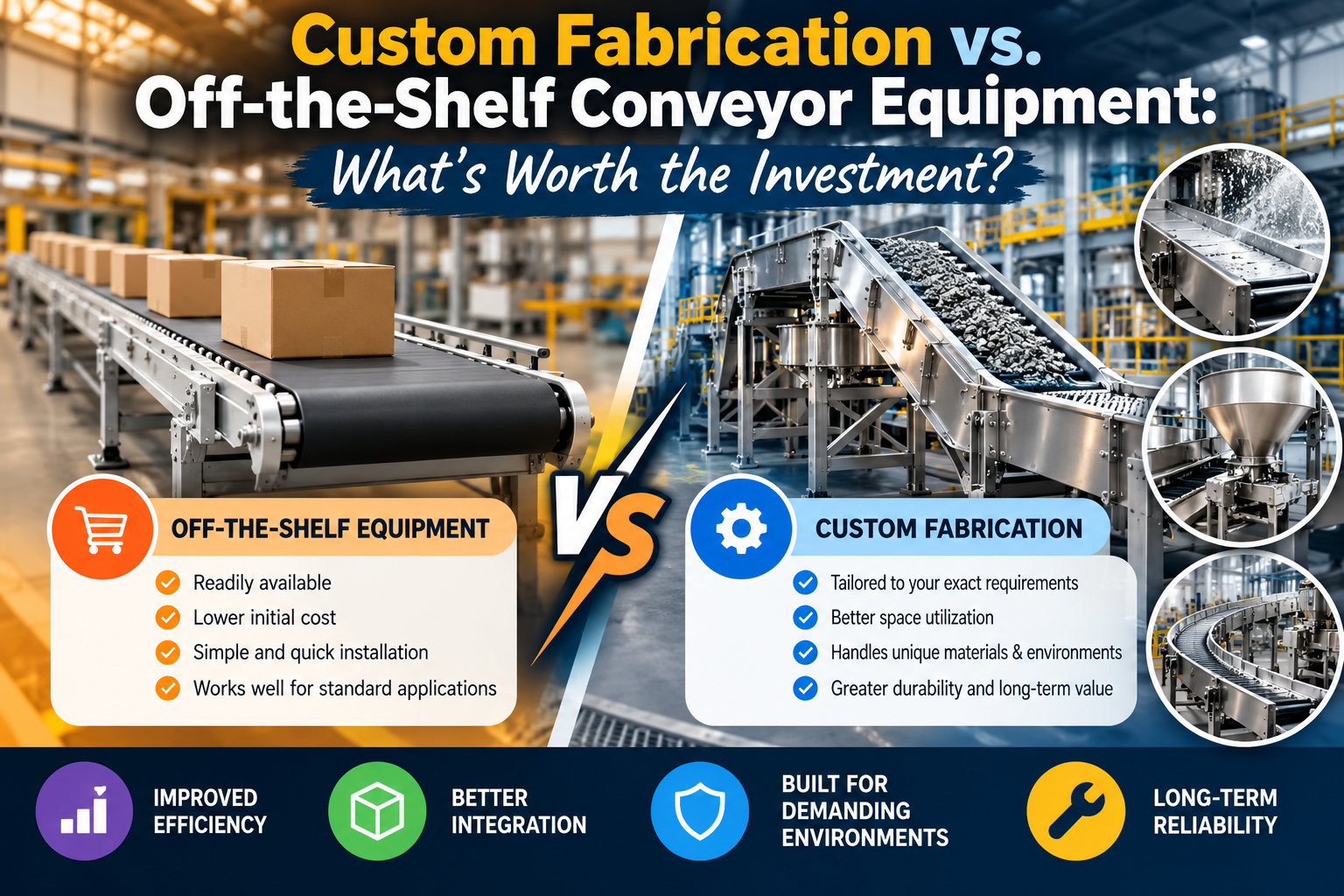
When selecting a new conveyor system for a manufacturing plant, one of the initial questions that must be answered is whether to buy a standard conveyor or go for Custom Fabrication. The advantage of using a standard conveyor system is that it is readily available and requires little engineering work. However, a custom conveyor system can be designed based on the exact specifications of the facility, materials, and process.
The decision to go for one option or another cannot be made solely based on the initial cost of purchasing the system. Issues like capacity, material, space, environment, maintenance, installation, and durability can also make a difference in the real value of the conveyor system.
In certain cases, the best solution will be the standard system, while in other cases, custom fabrication will have its advantages.
What Is Custom Conveyor Fabrication?
What is meant by custom fabrication means the design and manufacture of equipment tailored to fit the application's requirements, rather than the use of a ready-made design.
A custom conveyor could be designed based on the requirements of a particular conveyor length, width, height, discharge point, material, capacity, operating temperature, or building layout.
CustomFabrication Services may include the manufacture of conveyor frames, troughs, chutes, hoppers, screw conveyors, feeders, guards, support structures, and other material handling parts.
The end does not justify the means in this case; the aim is to design equipment that solves a certain material handling problem.
What Makes Off-the-Shelf Equipment Attractive?
Standard conveyor equipment has an obvious advantage: simplicity.
When an application matches an existing design, purchasing standard equipment can reduce engineering time and potentially shorten procurement schedules. Replacement components may also be easier to source when the system uses common dimensions and widely available parts.
Off-the-shelf equipment may make sense when:
- The material is relatively easy to handle
- Required capacity is within standard equipment ranges
- The facility has adequate installation space
- Standard dimensions fit the process
- Environmental conditions are not unusual
- Integration with other equipment is straightforward
- The system does not require specialized materials or features
For these applications, custom fabrication may add complexity without providing enough additional value.
However, problems arise when a standard conveyor must be repeatedly modified to fit a facility or process. At that point, the apparent savings of standard equipment can diminish.
When Custom Fabrication Becomes Worth the Investment
Custom fabrication becomes particularly valuable when the application has requirements that standard equipment cannot easily accommodate.
Consider a facility with limited floor space, unusual ceiling heights, multiple transfer points, or a difficult material. A standard conveyor might technically move the material, but it may require additional transfers, structural modifications, or workarounds to fit the facility.
A custom system can instead be designed around those constraints from the beginning.
This can provide benefits such as:
- Better use of available space
- More efficient material flow
- Improved equipment integration
- Application-specific durability
- Easier maintenance access
- Greater flexibility for unusual layouts
- Reduced need for field modifications
The initial investment may be higher, but the total value can be greater when the equipment performs more effectively within the actual production environment.
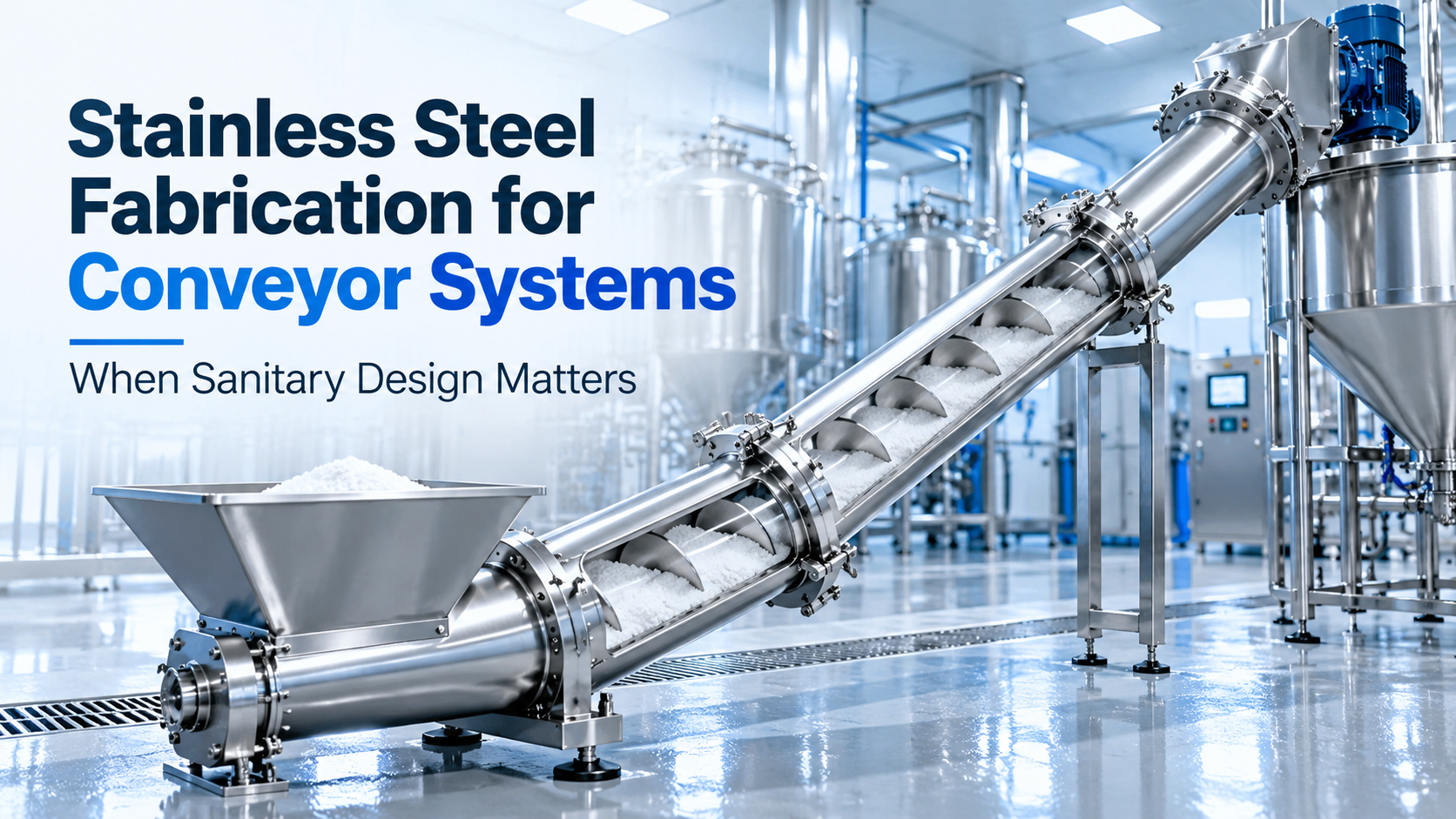
Stainless Steel Fabrication for Demanding Environments
Material selection is another area where custom fabrication could prove beneficial.
If any of the factors, such as corrosion resistance, sanitary issues, durability, or exposure to moisture and chemicals, are important considerations, then Stainless Steel Fabrication could be used.
There could be some applications that would need equipment that goes beyond the usual construction of carbon steel.
This type of custom-fabricated conveyor could include the right stainless steel grades, finish, welding pattern, support, and other elements in relation to its environment of operation.
It would be even more relevant when it comes to equipment that will have to endure frequent washdown or minimal contamination of the products.
It will have to be made of the right material in relation to the right application and its environment of use.
Industrial Equipment Fabrication Goes Beyond Conveyors
Conveyors rarely operate as completely independent pieces of equipment. They are usually part of a larger material-handling system.
This is where Industrial Equipment Fabrication can offer additional value.
A facility may need a conveyor integrated with:
- Hoppers and bins
- Feeders
- Chutes
- Screens
- Crushers
- Processing equipment
- Storage systems
- Dust-control equipment
- Packaging machinery
- Existing conveyors
If standard components do not align with the existing system, fabrication may be required to create appropriate transitions, supports, guards, or transfer points.
Instead of treating each piece of equipment as a separate purchase, custom fabrication allows the overall system to be considered as a connected process.
Heavy Duty Fabrication for Challenging Applications
Some facilities operate conveyors under demanding conditions that require more than standard construction.
Heavy Duty Fabrication may be suitable for uses where abrasive material, high volume, continuous operation, heavy loads, or an industrial environment apply.
Conveying high volumes of abrasive bulk material would cause excessive wear on the screw flights, troughs, chutes, and other components. Heavy Duty Fabrication would allow the use of suitable materials that will resist wear and the use of suitable drives.
It is important to tailor the fabrication to the specific use.
Unnecessarily overstressing all conveyors would increase the weight and cost unnecessarily. Conversely, under-fabricating conveyor equipment may lead to excessive wear and costly maintenance.
Compare Total Cost, Not Just Purchase Price
One of the biggest mistakes in evaluating conveyor equipment is focusing exclusively on the initial purchase price.
A lower-cost standard conveyor may become more expensive over its service life if it requires frequent modifications, causes material bottlenecks, is difficult to maintain, or does not integrate efficiently with existing equipment.
A custom conveyor may have a higher initial cost but potentially provide better long-term value through improved fit and performance.
When comparing options, manufacturers should consider:
Initial equipment cost: What is the purchase price, including engineering and installation?
Installation: Will the equipment require extensive structural modifications or field fabrication?
Maintenance: How accessible are wear components, bearings, drives, and other service points?
Downtime: Could poor equipment fit or difficult material flow cause production interruptions?
Energy consumption: Is the system appropriately sized and configured for the required workload?
Service life: Is the construction suitable for the material and operating environment?
Future needs: Can the system accommodate reasonable changes in production capacity or layout?
This broader analysis provides a more useful picture of return on investment.
Custom Fabrication Can Solve Space Constraints
Space can be another very powerful reason for using custom fabricated equipment.
It could be the case that the plant or facility already has columns, walls, overhead obstructions, production machinery, or restricted routes of travel that make standard dimensions of conveyors unsuitable.
A custom-designed system can be built around such constraints.
For instance, the height at which the conveyor discharges could have been predetermined by existing machinery. Changing the machinery could be much more costly than redesigning the conveyor around the pre-existing equipment.
In this regard, Industrial Custom Fabrication can make a challenging situation workable.
When Standard Equipment Is Still the Better Choice
Custom fabrication is not automatically the right answer.
If a standard conveyor meets the required capacity, fits the available space, handles the material appropriately, and integrates easily with the rest of the process, there may be little reason to pay for extensive customization.
Standard equipment can provide:
- Faster procurement
- Familiar components
- Simplified replacement
- Predictable configurations
- Lower engineering requirements
- Potentially lower upfront costs
The goal should be to select the simplest equipment that reliably satisfies the application's requirements.
Working With an Experienced Fabricator
The value of custom equipment depends heavily on the quality of the engineering and fabrication behind it.
An experienced fabricator should be able to evaluate the material, throughput, layout, operating environment, maintenance requirements, and integration points before recommending a design.
Conveyors Incorporated provides custom conveyor and bulk material-handling solutions, including screw conveyors and feeders manufactured in standard CEMA configurations or custom dimensions. Its capabilities allow equipment to be developed around individual application requirements rather than relying exclusively on standardized configurations.
For manufacturers, this application-focused approach can be particularly valuable when material characteristics, space limitations, or operating conditions make standard equipment difficult to use effectively.
So, What's Worth the Investment?
Off-the-shelf equipment is often the better investment when the process is straightforward and standard equipment already meets the required specifications.
Custom Fabrication is often worth the investment when the facility has unusual space constraints, demanding materials, specialized sanitation requirements, challenging operating conditions, or complex equipment-integration needs.
The most important consideration is total value over the equipment's useful life not simply the lowest initial price.
A well-designed custom conveyor can fit the process more effectively, reduce unnecessary modifications, improve maintainability, and provide construction suited to the actual operating environment. In demanding applications, those advantages can outweigh the additional upfront engineering and fabrication costs.
Ultimately, manufacturers should compare standard and custom options based on performance, reliability, installation, maintenance, service life, and long-term operating costs. When an application falls outside the capabilities of standard equipment, partnering with an experienced provider of Custom Fabrication Services can be the difference between making a conveyor fit the process and designing a conveyor that was built for it from the start.