Bucket Elevator Manufacturer Checklist: Questions to Ask Before You Buy
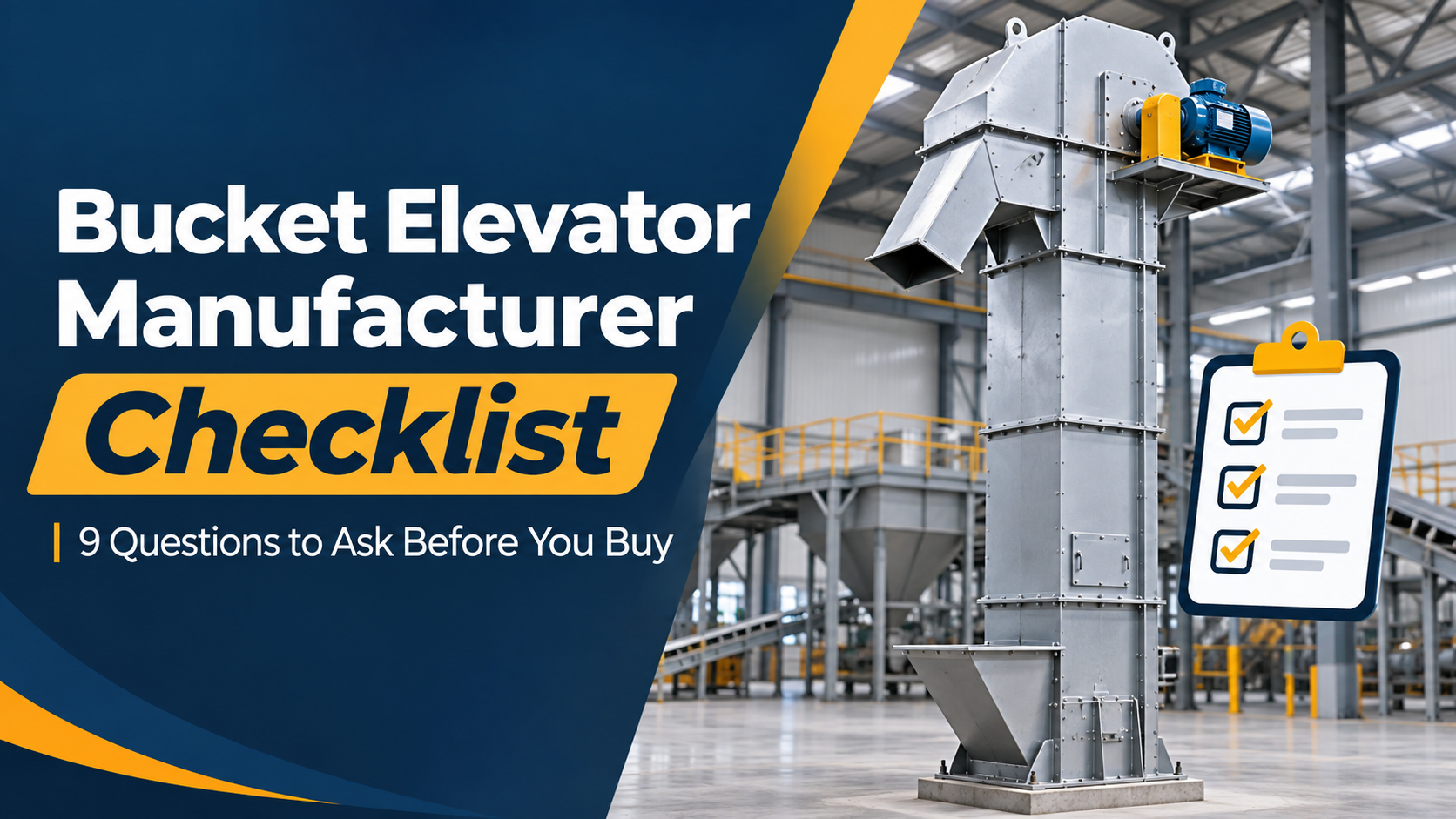
Selecting the right Bucket Elevator Manufacturer is one of the crucial parts of the process of moving a variety of bulk materials from one point to another in a safe and effective way. Besides agriculture and food products, bucket elevators are used for moving minerals, chemicals, and even industrial powders.
All bucket elevators are not equal; different things influence the performance of these devices. Through proper questions, you will be able to choose the perfect bucket elevator for your needs.
It doesn’t matter whether you want to buy standard equipment or Custom Bucket Elevators – here are the questions will come in handy in your evaluation process.
Does the Manufacturer Understand Your Material?
First and foremost, when speaking with any Bucket Elevator Manufacturer, you should inquire if they have had experience with materials like yours.
There are many variables in terms of the type of bulk material, including density, particle size, moisture content, abrasiveness, temperature, and flowability.
Each will have an effect on the bucket selected and the design of the system itself.
Before requesting a quotation, provide detailed information about your material, including:
- Material type and bulk density
- Particle size and distribution
- Moisture content
- Abrasiveness and corrosiveness
- Material temperature
- Required conveying capacity
A manufacturer that evaluates these factors can recommend equipment better suited to your application.
What Types of Industrial Bucket Elevators Do You Offer?
The next thing to check is if the supplier offers different types of elevators for your process.
The Industrial Bucket Elevator comes in various designs based on your material type, capacity, conveying height, and other factors.
Some common types of elevators are:
- • Centrifugal discharge elevators: Usually used for easily flowing materials and discharging materials at high speeds.
- • Continuous discharge elevators: Materials move more gently than in centrifugal discharge elevators; hence, they can be used for some delicate materials.
- • Belt type elevators: In this type of elevator, a belt moves and carries buckets of the material.
- • Chain type elevators: Chains move buckets of materials; therefore, they are used in applications suitable to their construction and operational nature.
All configurations may not suit all materials. Therefore, inquire from your manufacturer regarding the most suitable configuration for your application.
An experienced supplier that uses various bulk material handling technologies will be able to coordinate with the other parts of your conveying system.
Can You Provide Custom Bucket Elevators?
The standard equipment may not suit the layout dimensions, process considerations, and operating conditions of your facility.
Here comes the added flexibility offered by Custom Bucket Elevators. Customization can be done in terms of elevator height, bucket size, casing sizes, drive system, discharge setup, construction material used, and coordination with other equipment already present.
If the facility has limited headroom and/or floor space, it will need a completely different arrangement than a brand-new facility with more scope for installation flexibility.
Enquire about the capability of the manufacturer to adapt itself to your layout and offer custom engineering to coordinate your elevator with other connected conveyors, hoppers, bins, and processing equipment.
Conveyors Inc. provides industrial conveying equipment and bulk material handling systems for various applications. While looking at your supplier, think about the overall material handling flow of the process.
What Capacity and Conveying Height Can the System Handle?
"Capacity is a key element when selecting a bucket elevator."
It is possible that you will end up with bottlenecks if the system fails to fulfill your requirements in terms of production. On the other hand, the wrong choice of equipment for your project will be an added burden.
Get details from the manufacturer regarding the capacity of the chosen elevator and how it was rated. Several factors may affect capacity, such as material density, bucket fill, spacing, speed, and discharge properties.
It is also necessary to specify the desired conveying height, inlet arrangement, discharge point, and operational schedule.
Ensure that the capacity of the chosen elevator suits the equipment it supplies.
How Is the Equipment Designed for Durability?
Industries have the potential to introduce abrasive particles, heavy-duty material handling, dust, moisture, and frequent running cycle conditions for bucket elevators.
Contact the vendor for suitable material and component considerations based on your needs. Based on the type of material and conditions, some of these may include:
- - Casing material
- - Bucket construction
- - Belt / Chain choice
- - Wear-resistant parts
- - Bearings
- - Drive components
If it is an abrasive application, wear resistance becomes a key concern. Similarly, if it is a corrosive condition, material compatibility would become a key factor.
It may also be worthwhile to learn what the vendor does for dust containment, accessibility, and replacement of worn-out components.
What Safety Features Are Included?
The bucket elevator has moving mechanical parts and may work with flammable or dusty or some other hazardous materials. This means that the considerations about safety become very important at the stage of choosing equipment.
Ask the manufacturer what kind of protection, access, and other safety measures are needed in your case.
Depending on the particular system and requirements, they may include inspection doors, emergency stop, belt tracking, speed measurement, and some other abnormal operation detection devices.
If your material is hazardous in some way, discuss the risk assessment, design requirements, and regulation issues with experts.
The consideration of safety must be done during the stage of designing the elevator, not later.
Are Replacement Parts and Maintenance Support Available?
However, even properly engineered equipment needs periodic inspection and maintenance. Prior to the purchase of an item, you should clarify if the company is able to supply the spare parts and provide service guidelines.
Clarify the issues of buckets, belts, chains, bearings, sprockets, drive units, and other elements that are needed for the chosen type of machine.
It is also important to know about the required periodic inspection, lubrication, wear, and maintenance issues.
Access to the replacement parts will be helpful when the repair is needed.
In choosing the manufacturers, think not only about the cost but also about the support during the whole life span of the elevator.
Can the Bucket Elevator Integrate with Your Existing System?
The bucket elevator can be part of a whole process of material handling, receiving materials from a screw or belt conveyor, feeder, or hopper and delivering them to the storage or processing equipment.
Consult the manufacturer regarding how the elevator connects with these pieces of equipment and whether the suggested setup allows for the necessary flow of materials.
The following questions need to be considered: inlet and discharge geometry, transfer points, support structures, control systems, space available, and access for maintenance.
In cases of complex setups, coordinating the elevator with the whole system of conveyors can decrease material build-up and transfer issues.
What Is the Total Cost of Ownership?
Purchase price alone does not make up the whole investment. There are other factors which can contribute to the cost of ownership including installation, power consumption, inspection, spare parts, repairs, and even unexpected downtime.
Make sure you get clear from the manufacturer what they mean by their quotation, such as engineering, fabrication, accessories, documentation, and installation.
When comparing proposals, take into account the following aspects: suitability of the equipment, required maintenance, operating conditions, and technical support.
A system that is right for your material and conditions can prove more effective than an expensive solution that will require frequent repairs or cannot help you achieve your production goals.
Conclusion: Choose the Right Bucket Elevator Manufacturer
The selection of the most appropriate Bucket Elevator Manufacturer should be based on an analysis of material properties, machine design, capacity, reliability, safety, maintenance, and system integration.
Asking yourself these questions prior to the purchase will allow you to better determine whether a manufacturer has sufficient engineering knowledge and equipment for your needs.
No matter whether you need either Industrial Bucket Elevators or Custom Bucket Elevators, the most effective solution will always be a tailor-made product, taking into account all your needs and plans.
Conveyors Inc. designs and manufactures industrial conveyor equipment and bulk material handling systems for challenging applications. To make sure that you have done everything right in order to choose the most appropriate manufacturer, you should gather information regarding your materials, required capacity, conveying height, and more.
Have a bucket elevator project in mind? Let’s discuss your requirements and find the right solution for your operation.
📞 Call Conveyors Inc. today at (817) 473-4645
📍 620 S. 4th Ave, Mansfield, Texas 76063
🌐 Visit: Conveyors Inc.