Types of Industrial Screw Conveyors: Horizontal, Inclined & Shaftless Explained
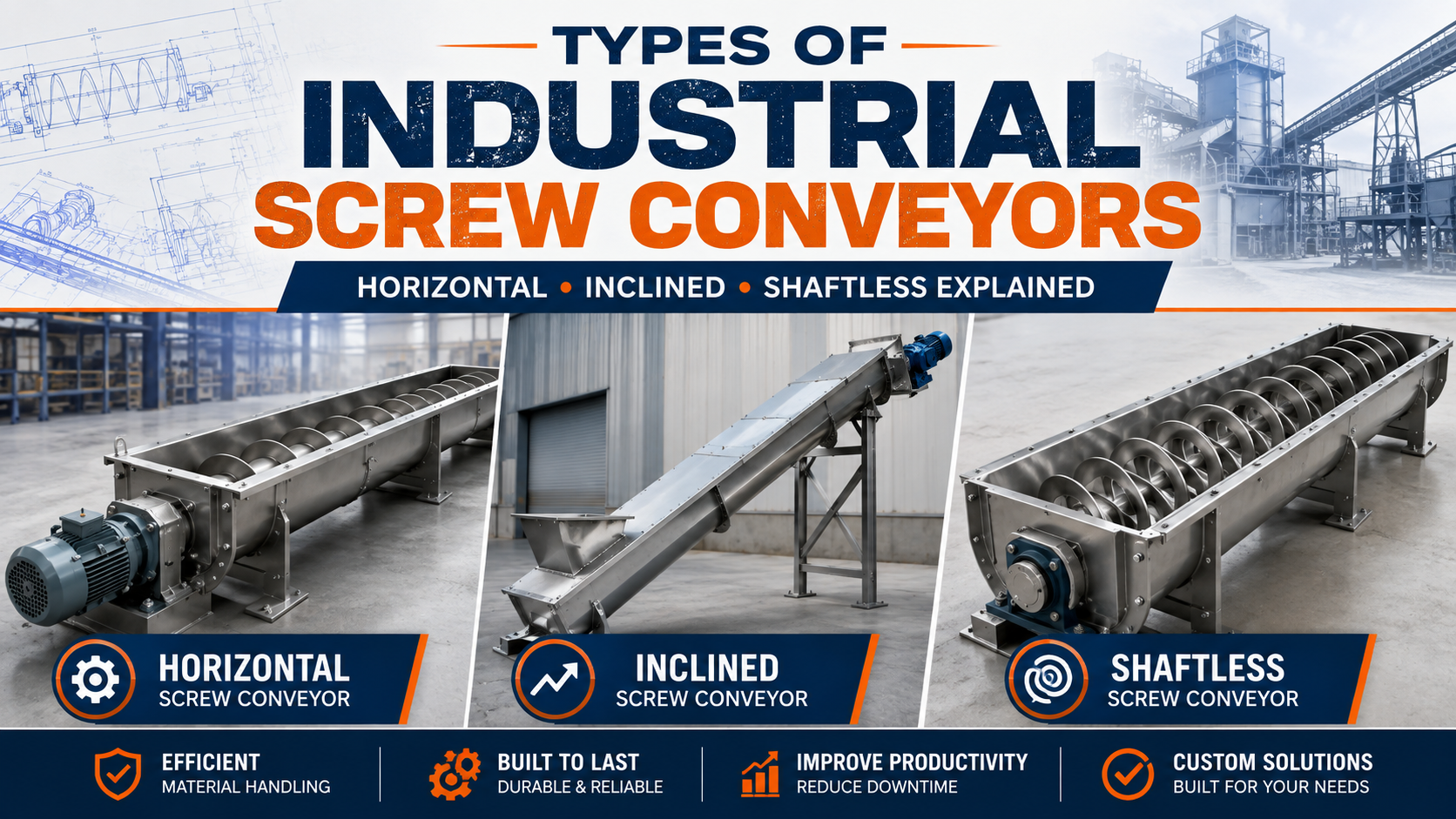
For transferring bulk materials in an efficient, effective, and safe manner, a Screw Conveyor is one of the most flexible conveying systems that has been widely employed in many industrial units. Irrespective of whether it is powder, granules, or any kind of tough-to-handle material, screw conveyors have always been designed according to the needs of different processes.
It should also be noted that not all applications need the same kind of conveyor system. This is because of the varied characteristics associated with horizontal, inclined, and shaftless screw conveyors.
By knowing the different attributes of the aforementioned systems, plant managers and engineers can choose the right Industrial Screw Conveyor for them.
What Is a Screw Conveyor?
The screw conveyor is a mechanical conveying system in which an inclined or horizontal screw rotates to move bulk solids within a trough, tube, or any enclosed container.
Screw conveyors find extensive application in industries such as food processing, the agricultural industry, chemical industry, wastewater treatment plants, mining, and general industrial manufacturing.
Flexibility of a screw
conveyor is one of its greatest strengths. There are many different
possibilities when it comes to configuring screw conveyors, including length,
capacity, inclination, type of material being conveyed, and many others.
Manufacturers even offer a Custom Screw
Conveyor tailored
to the needs of a particular material handling process.
There are three main
types of screw conveyors described below.
1. Horizontal Screw Conveyor
The Horizontal Screw Conveyor is designed to convey bulk materials mainly in a horizontal direction. This type of screw conveyor is the most common design because it is efficient in conveying materials without being complex in design.
For the horizontal screw conveyor, the screw flights rotate inside the housing to move materials from the entry point to the discharge end. Since the conveyor is not required to cover a high vertical distance, it will be efficient in conveying materials.
Advantages of Horizontal Screw Conveyors
Horizontal screw conveyors are particularly useful when:
Another advantage is that a horizontal configuration can be adapted to different lengths and capacities. Depending on the material being handled, the conveyor can also be designed with different flight types, trough configurations, and construction materials.
Because screw conveyors can be enclosed, they may also help contain dust and reduce exposure to the surrounding environment compared with some open conveying systems.
2. Inclined Screw Conveyor
Inclined screw conveyors
are positioned at an angle so that the material is conveyed from a low level to
a high one. Such installations are suitable when there is a need for the plant
to overcome elevation differences without implementing a full vertical conveyor
system.
Such types of conveyors
are usually used for the transfer of material between process stages, to feed
elevated machinery, and transport bulk materials from storage areas to elevated
discharge locations.
But the inclination
influences the efficiency of operation of such systems. The more the
inclination, the stronger the force of gravity pulls back the material.
Key Considerations for Inclined Screw Conveyors
When selecting an inclined screw conveyor, engineers should consider:
The material's characteristics are especially important. Particle size, density, moisture content, cohesiveness, and flowability can all influence how effectively material moves through an inclined conveyor.
Proper engineering and sizing are therefore essential. A conveyor designed
for a horizontal application may not perform the same way when installed at a
significant incline.
3. Shaftless Screw Conveyor
The Shaftless Screw
Conveyor involves the use of a screw conveyor flight without an axial shaft. As
opposed to using the shaft to rotate, the screw conveyor flight operates
without an axial shaft inside a specially designed trough or casing.
This design is especially
beneficial in transporting wet, sticky, stringy, or difficult-to-transport bulk
materials using normal shafted screw conveyors.
Bulk materials like
sludge, wastewater screenings, biosolids, and others could be conveyed using
this system.
Why Choose a Shaftless Screw Conveyor?
The lack of a center
shaft leads to an increased open space within the conveyor. This could mean
that there is less chance of materials sticking to the central shaft and that
it is able to perform in situations where traditional screws might have
difficulty.
The lack of a shaft could
also come in handy when conveying materials in what can be described as an
enclosed environment.
It is important to note
that like all other types of screw conveyors, proper selection of the right
design will depend on the material. Some of the factors to consider include
moisture, abrasiveness, temperature, density, and capacity.
Horizontal vs. Inclined vs. Shaftless Screw Conveyors
Each type of Industrial Screw Conveyor serves a different purpose.
|
Conveyor Type |
Typical Application |
Main Benefit |
|
Horizontal Screw Conveyor |
Level material transfer |
Efficient and straightforward conveying |
|
Inclined Screw Conveyor |
Moving material to a higher elevation |
Handles elevation changes |
|
Shaftless Screw Conveyor |
Wet, sticky, or difficult materials |
Reduces issues associated with a central shaft |
It is important to note that these configurations are not always mutually exclusive. A shaftless conveyor, for example, can also be designed for an inclined application. The ideal configuration depends on the complete set of application requirements.
Choosing the Right Industrial Screw Conveyor
Selecting the right Screw Conveyor requires more than simply choosing between horizontal and inclined designs. Engineers should evaluate the material being conveyed and the conditions under which the conveyor will operate.
Important factors include:
Material Characteristics
Consider the material's bulk density, particle size, moisture level, abrasiveness, temperature, and flowability. Sticky or stringy materials may require a shaftless design, while abrasive materials may require specialized wear-resistant components.
Capacity Requirements
Determine how much material needs to be moved per hour. Conveyor diameter, screw speed, pitch, and configuration can all affect throughput.
Conveyor Length and Layout
Available space and the required transfer distance can determine whether a horizontal, inclined, or customized configuration is most appropriate.
Elevation
If material must be lifted from one level to another, an inclined screw conveyor may provide a practical solution.
Construction Materials
Depending on the industry and operating environment, screw conveyors may be
manufactured from different grades and types of materials to meet durability,
sanitation, corrosion-resistance, or other requirements.
When a Custom Screw Conveyor Makes Sense
Conventional conveyor
systems may not suit the particular needs of specific industrial operations.
There may be a need for a Custom Screw Conveyor to suit the particular needs of
a specific plant setup.
This may include
dimensions of the conveyors, inlets, outlets, flighting design, housing,
drives, materials used to manufacture the system, among others.
It is important to work
with a conveyor manufacturer to ensure that the right equipment is designed for
the particular process and not the other way round.
Final Thoughts
The Horizontal, Inclined, and Shaftless Screw Conveyors all play a significant part in the handling of materials in industry. The Horizontal Screw Conveyor is a good choice when conveying horizontally. The Inclined Screw Conveyor would be useful in moving material at varying elevations, and the Shaftless Screw Conveyor is a good option when handling difficult materials.
The right screw conveyor for industrial use is contingent upon the type of material being handled, its capacity, layout, elevation, and environment. A Custom Screw Conveyor is the best option for specialized applications that require flexible handling of material.
For more information about screw conveyor systems and to see what configuration of industrial screw conveyor would work best for your application, contact Conveyors Inc.