Shaftless Screw Conveyors: Why Manufacturers Choose Them for Sticky, Abrasive Materials
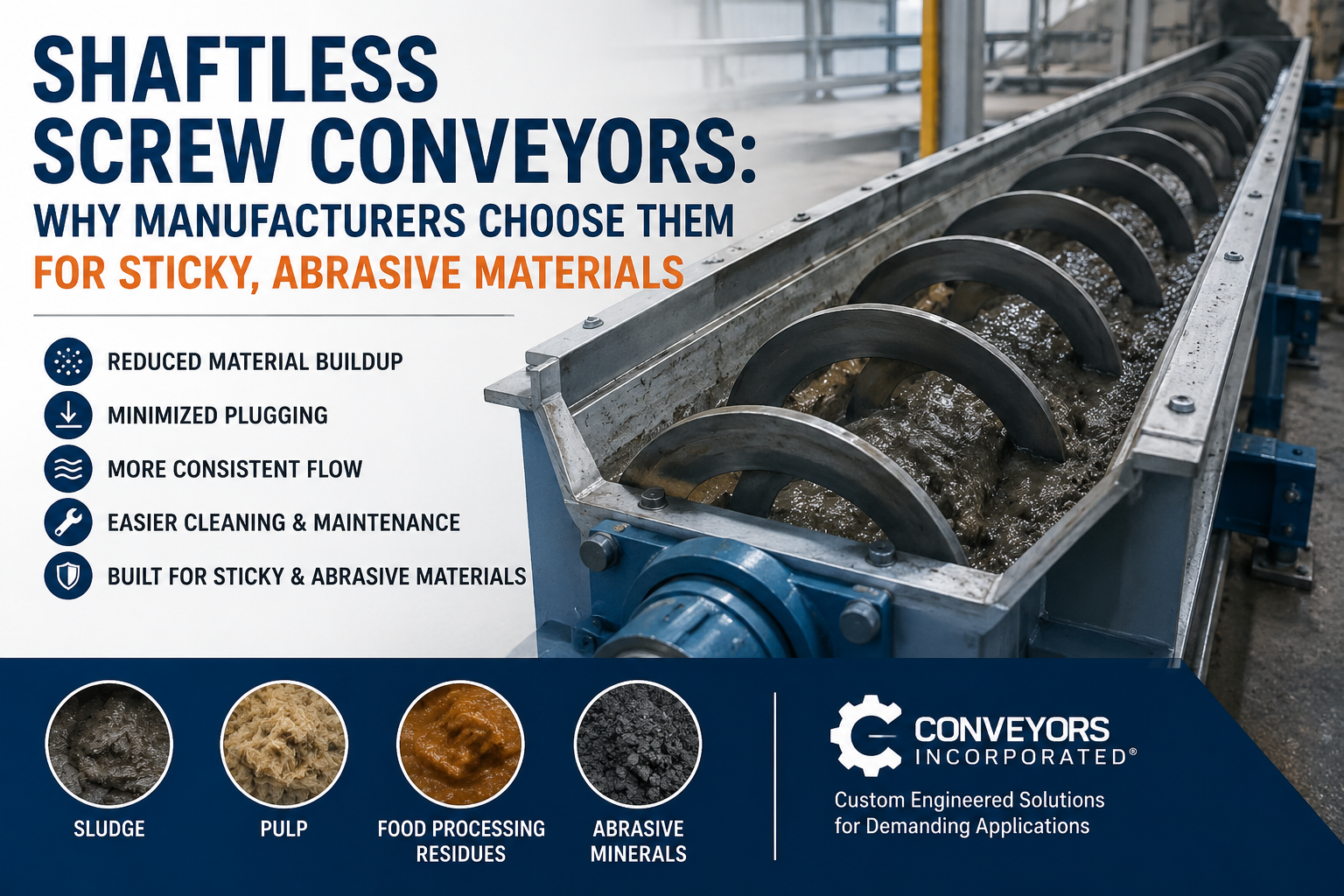
When bulk materials are sticky, wet, sluggish, abrasive, or difficult to move, conventional conveying equipment can quickly become a maintenance challenge. Material buildup can reduce capacity, abrasive particles can accelerate component wear, and traditional screw designs may create areas where difficult products accumulate.
That is where ShaftlessConveyors can provide a practical alternative.
A shaftless screw conveyor eliminates the center pipe found in a conventional shafted screw conveyor. Instead, a continuous spiral moves material through a trough, reducing the surfaces where sticky material can collect. This design is particularly well suited for demanding bulk-handling applications involving wet, viscous, fibrous, or abrasive products.
For manufacturers, the advantage is not simply a different conveyor configuration. A properly engineered shaftless system can improve material flow, simplify maintenance, and provide a more reliable solution for products that are challenging to convey.
What Is a Shaftless Screw Conveyor?
A shaftless screw conveyor operates on the principle of a rotating helix that has no shaft or pipe in its center.
In a standard screw conveyor, there is flighting on the center pipe. The center pipe can act as a surface where moist and sticky product can accumulate, especially at the place of contact between the flight and the pipe. Gradually, the accumulation can limit the conveying capability of the equipment and cause plugging.
In the shaftless screw conveyor, there is no center pipe, and therefore, it opens up the space available for conveying the material.
Industry guidelines for the design of engineering projects recommend shaftless screws for conveying sticky products and non-free-flowing materials.
Why Manufacturers Choose Shaftless Conveyors for Sticky Materials
Materials that are sticky can present a special challenge in mechanical conveying because they do not always convey without issues through the system.
Material with moisture content, oil, or any type of sticky substance could adhere to the screw flighting. Within a shafted conveyor, the center pipe is yet another place where material buildup occurs. Material buildup means there is less space within the conveyor for material conveyance.
The solution to this problem is to use a shaftless conveyor.
The shaftless conveyor is beneficial when working with sticky or wet bulk solid materials. Some examples of material that might be conveyed by shaftless conveyors include sludge, pulp, residues from the food processing industry, chemical material, and other slow-moving materials. Engineering guidelines indicate the ability of shaftless conveyor design to offer a non-clogging conveying surface.
For manufacturers, that can translate into:
- Less material buildup around the screw
- Reduced potential for plugging
- More consistent material movement
- Easier access for cleaning and maintenance
- Fewer internal components obstructing material flow
The exact benefits depend on the product characteristics, conveyor dimensions, operating speed, loading, and system configuration. That is why shaftless equipment should be engineered around the material rather than selected solely by conveyor size.
Handling Abrasive Materials Requires Heavy-Duty Design
In addition, abrasives pose their own set of problems. The use of such products will result in very rapid wear of the components that make up the conveyor if the machine is not designed for the task at hand.
Bulk solids that include, but are not limited to, such materials as sand, cement clinker, iron ore, minerals, and others can wear the conveyor flights, the troughs, the bearings, and other components very quickly indeed. It has been suggested through engineering that abrasion-resistant design, along with proper operating conditions, be utilized for abrasive materials.
This is when the Heavy Duty Shaftless Conveyors come into play.
Such a conveyor will have its own set of features, including stronger spiral construction, abrasion-resistant materials, special liners, and a drive system able to cope with the torque of sluggish or abrasive products. The idea is to make the conveyor's construction match the product.
Not all conveyors have to have the same construction whether they are used for dry, free-flowing product or dense, abrasive, high-moisture product.
The Advantage of Fewer Internal Obstructions
Another significant advantage of the shaftless conveyor is the lack of intermediate hanger bearings.
The long screw conveyor with the traditional design may need intermediate hanger bearings to bear the weight of the central shaft. Although hanger bearings play an essential role in supporting the shaft, they might become obstacles to the moving materials as well. By removing the obstacles from inside the screw, it becomes easier to prevent the material from building up in sticky, fibrous, or interlocking products.
In the shaftless screw, the spiral serves as a conveyor. The shaftless screw conveyor is especially helpful if the product is likely to wrap, bridge, or build up on traditional conveyor components.
Custom Shaftless Conveyors Are Engineered Around the Application
There is no single shaftless conveyor configuration that works for every material-handling application.
Important design considerations include:
- Material type and physical characteristics
- Bulk density
- Moisture content
- Stickiness or abrasiveness
- Particle size and consistency
- Required conveying capacity
- Conveyor length and incline
- Operating temperature
- Desired operating speed
- Trough and liner construction
- Drive and torque requirements
- Loading and discharge arrangements
These factors influence the conveyor's dimensions, spiral design, liner selection, drive requirements, and overall construction.
Conveyors Incorporated designs screw conveyors and feeders to CEMA standards or custom dimensions and highlights custom engineering as part of its bulk material handling capabilities. Its screw conveyor systems can be configured for applications ranging from free-flowing to sluggish materials.
For manufacturers dealing with difficult materials, Custom Shaftless Conveyors can therefore offer an opportunity to optimize the equipment around the actual process instead of forcing the process to fit an off-the-shelf conveyor.
Shaftless Conveyor Installation: What Manufacturers Should Consider
A properly designed conveyor still requires appropriate installation to function efficiently.
Installation Considerations for shaftless conveyors include considerations for equipment alignment, structure, driving, feeding and discharging conditions, lining installation, maintenance access, and compatibility with other machinery.
In addition, it should match the conditions of material feeding into the equipment. The feed rate, loading level, and operating speed can have a notable influence on operation and wear, especially in the case of abrasive and sticky materials. The recommendation from engineering is to focus on material properties, capacity, and operating conditions.
Such a plan can help avoid unnecessary changes during installation and simplify future maintenance work.
Choosing the Right Shaftless Conveyor Manufacturer
Selecting a ShaftlessScrew Conveyor Manufacturer is ultimately about more than purchasing a piece of equipment. Manufacturers should look for a supplier that understands bulk material characteristics and can engineer the conveyor around the application.
A qualified Shaftless Conveyor Manufacturer should be able to evaluate factors such as material behavior, required capacity, conveyor geometry, wear conditions, and drive requirements before finalizing the design.
That engineering approach is especially important when the material is both sticky and abrasive. A system designed primarily around stickiness may not provide sufficient wear resistance, while one designed only for abrasion may overlook the buildup and plugging issues associated with wet or adhesive materials.
The right solution balances both.
A Better Fit for Difficult Bulk Materials
For manufacturers moving sticky, wet, sluggish, fibrous, or abrasive materials, shaftless conveying technology can offer several meaningful advantages. Removing the center shaft reduces a common buildup point, while the absence of intermediate hanger bearings creates a more open conveying path. With the appropriate heavy-duty materials, liners, drive system, and operating parameters, the equipment can also be engineered for demanding abrasive applications.
The key is application-specific design.
Conveyors Incorporated provides custom bulk material-handling solutions and screw conveyor systems tailored to operational requirements. Its systems are available in standard CEMA configurations and custom dimensions, enabling engineered solutions for challenging conveying applications.
If your process involves material that routinely sticks to conventional screws, causes plugging, or rapidly wears standard conveyor components, Shaftless Conveyors may be worth evaluating. A properly engineered system can provide a cleaner material path, dependable transport, and a configuration better suited to the realities of difficult bulk solids.
Need a conveyor designed for a challenging material? Work with a Shaftless Conveyor Manufacturer that can evaluate your material, capacity, layout, and operating conditions and develop a solution around your process. Contact Us.