Flexible vs. Shaftless Screw Conveyors: Choosing the Right Fit for Your Process
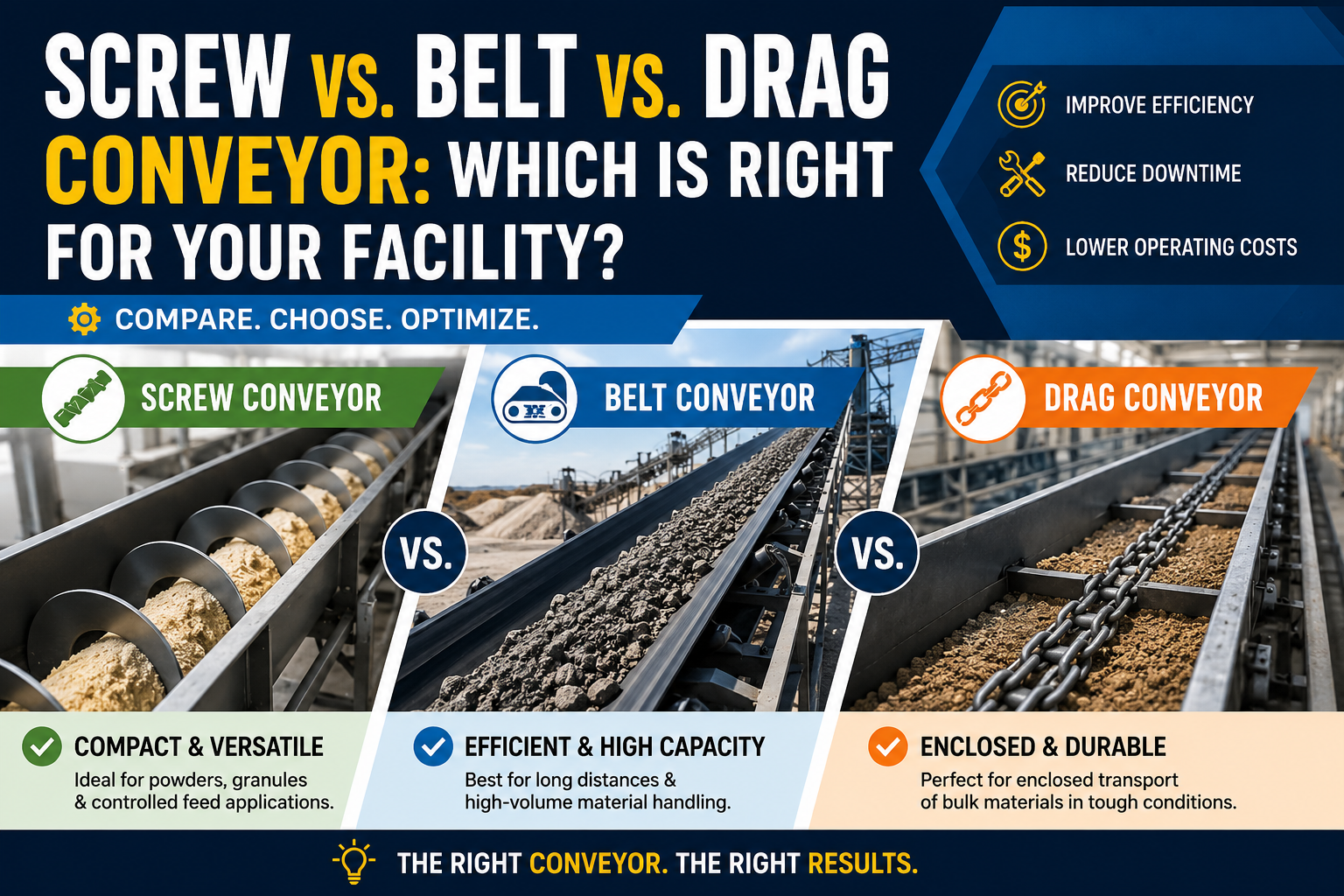
Choosing the right screw conveyor is an important decision for manufacturers handling powders, granules, bulk solids, and other materials. The conveyor needs to do more than move material from one point to another. It must match the material characteristics, layout, capacity requirements, maintenance expectations, and operating conditions of the process.
Two options that are often considered for specialized applications are the flexible screwconveyor and the shaftless screw conveyor. Although both use a rotating screw to transport material, their designs and ideal applications are different.
Understanding those differences can help manufacturers determine whether a flexible, shaftless, or another screw conveyor configuration is the better fit.
What Is a Flexible Screw Conveyor?
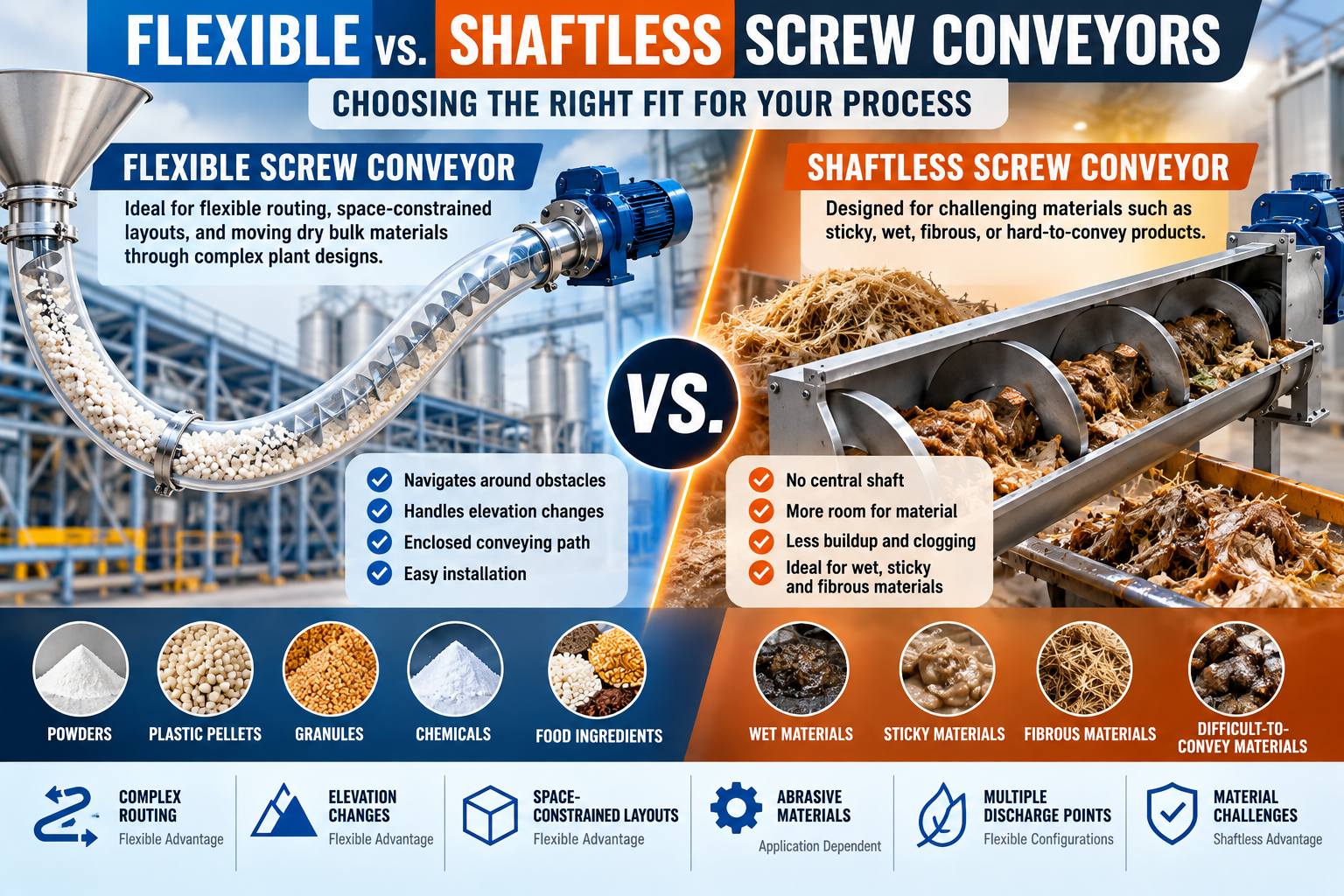
The flexible screw conveyor utilizes a flexible screw mounted on a tube that may be either flexible or rigid in nature. The screw turns at very high speeds and moves material inside the conveying tube towards the discharge point.
Flexibility is one of the main strengths of a flexible screw conveyor as it allows the conveyor to navigate around objects and handle elevation changes as well. Unlike most conveyors, which have to follow a particular route, the flexible type is able to work around equipment, pass below buildings, and work in places where installing rigid conveying machinery is not feasible.
Therefore, flexible conveyors work best in cases where there is limited space, or there is a need for more than one conveying route.
Most applications of flexible conveyors involve transporting dry bulk materials like powders, pellets, granules, and similar freely flowing products. Flexible conveyors also provide an enclosed conveying path.
What Is a Shaftless Screw Conveyor?
The other advantage of a shaftless screw conveyor is the absence of the central shaft present in conventional screw conveyors with shafts.
Unlike the flexible screw conveyor, the spiral of the shaftless screw conveyor usually works inside the rigid trough or housing, and not in a flexible tube.
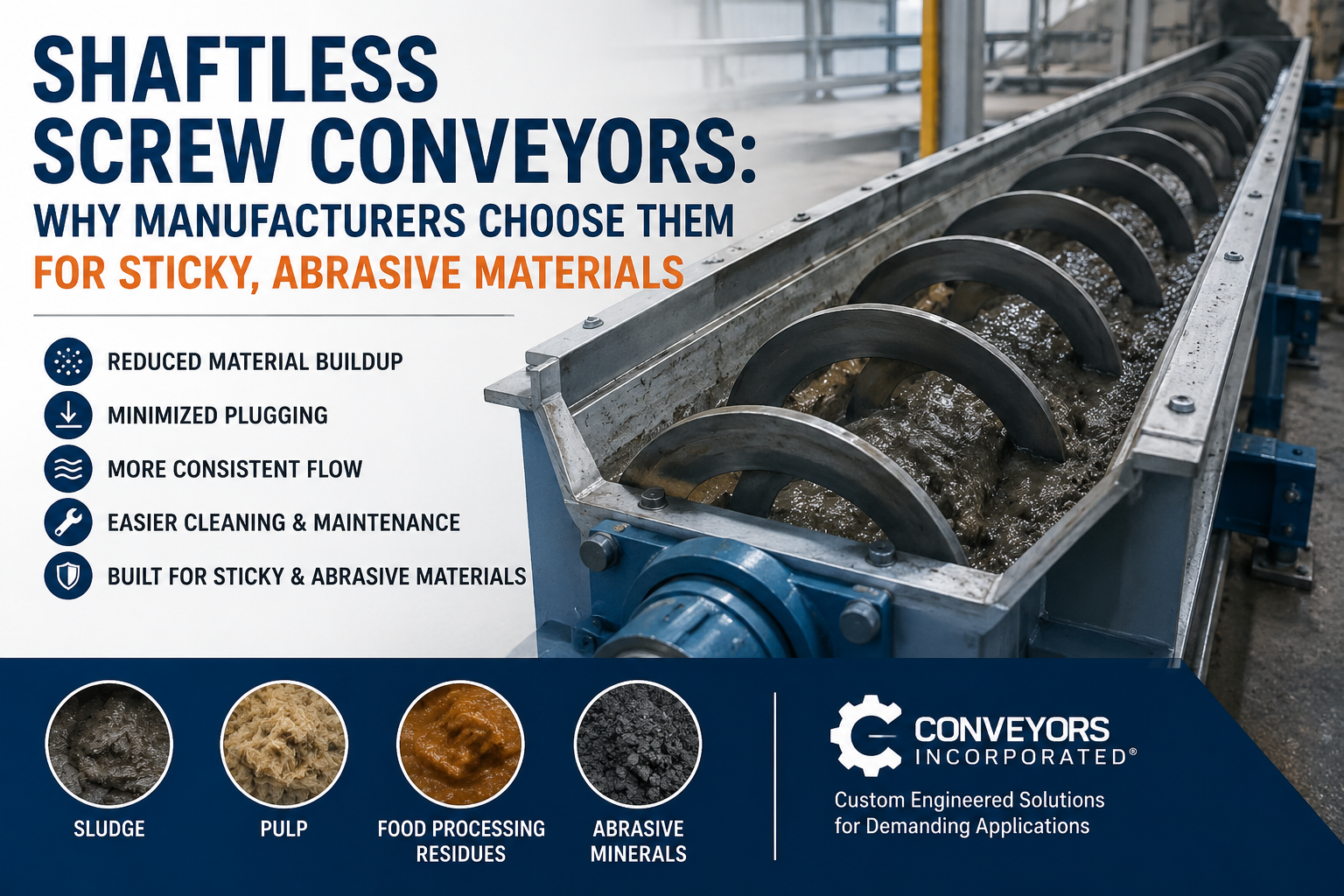
The lack of the shaft is especially beneficial for wet, sticky, viscous, fibrous, or hard-to-convey material. The removal of the central shaft allows the material to have more room in the conveyor.
In addition, the lack of intermediate bearing hangers may be possible, which will minimize the obstacles inside the conveyor.
For these reasons, shaftless screw conveyors are usually used when the material is challenging, not the conveying path.
Flexible vs. Shaftless: The Main Difference
The simplest way to distinguish these systems is to consider what problem each design is intended to solve.
A flexible screwconveyor is primarily advantageous when manufacturers need routing flexibility and a relatively simple way to move dry bulk materials through a complex plant layout.
A shaftless screwconveyor is often better suited to difficult materials that are sticky, wet, fibrous, or prone to buildup.
That does not mean one system is universally better than the other. The correct choice depends on the application.
|
Consideration |
Flexible Screw Conveyor |
Shaftless Screw Conveyor |
|
Dry powders and granules |
Excellent fit |
Good fit |
|
Sticky or viscous materials |
Application dependent |
Often a strong fit |
|
Wet materials |
Limited/application dependent |
Strong fit |
|
Complex routing |
Excellent |
More limited |
|
Elevation changes |
Excellent |
Application dependent |
|
Abrasive materials |
Application dependent |
Can be engineered for demanding service |
|
Fibrous materials |
Application dependent |
Often advantageous |
|
Multiple discharge points |
Flexible configurations possible |
Depends on design |
|
Space-constrained layouts |
Strong advantage |
Depends on installation |
The table is a general comparison. Material testing and application engineering should determine the final conveyor selection.
When a Flexible Screw Conveyor Makes Sense
A flexible screw conveyor can be an excellent choice when plant layout is a major consideration.
Because the conveying tube can be routed around existing equipment, a flexible system may reduce the need for complex transfer arrangements. It can also simplify conveying between different elevations or between equipment positioned at different locations within a facility.
Another advantage is relatively straightforward installation. Flexible systems can often be configured without the extensive structural support required by some rigid conveyor arrangements.
A flexible screw conveyor may be particularly appropriate for:
- Powders and dry ingredients
- Plastic pellets
- Granular products
- Chemicals and dry additives
- Food-processing ingredients
- Pharmaceutical powders
- Small-volume or intermittent conveying
- Applications requiring flexible routing
For example, a plastic screw conveyor application may involve moving plastic pellets from a hopper to processing equipment. If the pellets are free-flowing and the plant layout requires a curved conveying route, a flexible system may offer an efficient solution.
When a Shaftless Screw Conveyor Is the Better Choice
Shaftless conveyors become more attractive when material flow characteristics are more challenging.
Sticky sludge, wet solids, fibrous waste, and other difficult materials can accumulate around the center shaft of a conventional screw conveyor. A shaftless design eliminates that central shaft and can provide a more open conveying path.
This makes shaftless equipment particularly useful in applications where buildup and plugging are significant concerns.
Shaftless conveyors are commonly considered for applications involving wastewater screenings, dewatered sludge, food-processing waste, pulp and paper materials, and other difficult bulk solids.
The conveyor can also be fitted with appropriate liners and heavy-duty components when abrasion is a concern. Proper design is essential because abrasive materials can significantly increase wear on the screw and trough.
Consider Material Characteristics First
Before selecting either system, manufacturers should examine the material being conveyed.
Important questions include:
- Is the material dry or wet?
- Does it flow freely or tend to bridge?
- Is it sticky or cohesive?
- Is it abrasive?
- Does it contain long fibers?
- What is its bulk density?
- What particle size range is involved?
- How much material must be moved per hour?
- Is the material temperature-sensitive?
These questions can quickly narrow the available conveyor options.
For example, a dry, free-flowing powder may work well with a flexible screw conveyor, while a wet and sticky product may be better suited to a shaftless design.
What About Feed Screw and Cooling Screw Conveyors?
Different process requirements can also influence the screw conveyor configuration.
A feed screw conveyor is designed to provide controlled material feeding, often into downstream processing equipment. Consistent feed rate, screw geometry, speed, and material characteristics become especially important in these applications.
A cooling screw conveyor, meanwhile, is designed to move and cool material as part of the conveying process. These systems may incorporate specialized trough or jacket arrangements to facilitate heat transfer while the product moves through the conveyor.
Neither application should be selected solely based on the conveyor's name. The screw design needs to reflect the material, desired throughput, temperature requirements, residence time, and overall process.
When a Double Screw Conveyor Is Worth Considering
Some applications require greater control over material movement or additional conveying capacity. In these situations, a double screw conveyor may be considered.
Two screws operating within the same conveying arrangement can provide advantages depending on the material and process requirements. Double-screw designs can be useful for applications involving mixing, controlled movement, or difficult material characteristics.
However, adding a second screw also changes the equipment's power, space, maintenance, and design requirements. It should therefore be selected based on a specific process need rather than simply as a higher-capacity alternative.
Custom Engineering Makes the Difference
There is no universal screw conveyor that fits every application.
Conveyor length, inclination, required capacity, material density, operating speed, inlet and discharge configuration, available space, and maintenance access can all influence the final design.
Conveyors Incorporated provides screw conveyor and feeder solutions in standard CEMA configurations as well as custom dimensions, allowing systems to be engineered around individual material-handling requirements.
This is particularly important when choosing between flexible and shaftless conveying. The right technology should be determined by the complete application rather than by the conveyor type alone.
Choosing the Right Conveyor for Your Process
The decision between a flexible screw conveyor and a shaftless screw conveyor ultimately comes down to the problem you need the equipment to solve.
Choose a flexiblescrew conveyor when routing flexibility, compact installation, and the movement of dry bulk materials are major priorities. It can be a practical option for powders, granules, plastic pellets, and similar free-flowing products where the conveying path needs to navigate around existing equipment.
Consider a shaftless screw conveyor when the material is sticky, wet, fibrous, or otherwise difficult to move through conventional screw equipment. Its open screw design can help address material buildup and eliminate internal hanger-bearing obstructions.
For specialized applications, options such as a plastic screw conveyor, feed screw conveyor, cooling screw conveyor, or double screw conveyor may provide additional process-specific advantages.
The
ultimate solution to the effective choice of a suitable conveyor is first and
foremost knowing the material itself and the entire process. Through proper
analysis of material properties, arrangement, capacity, temperature,
maintenance needs, and other factors, it will be possible for the conveyor
supplier to pick the appropriate system, which will guarantee reliable
operation, not just convenience of design.
In case there are any special requirements in the application, consulting with an experienced conveyor producer may prove effective.