Signs Your Industrial Conveyor System Needs Repair Before It Fails
However, despite how well-made such industrial conveyors are, they still need proper inspection, maintenance, and occasional repair. The smallest issue, if ignored, might eventually lead to a mechanical failure that will cause unplanned downtime and will cost a lot of money due to emergency repairs.
In order to be able to avoid such costly mistakes, one should know about some early warning signs and take care of problems before they get out of hand. With the help of Professional Conveyor Repair Services, you will be able to detect any worn parts or mechanical issues before it is too late.
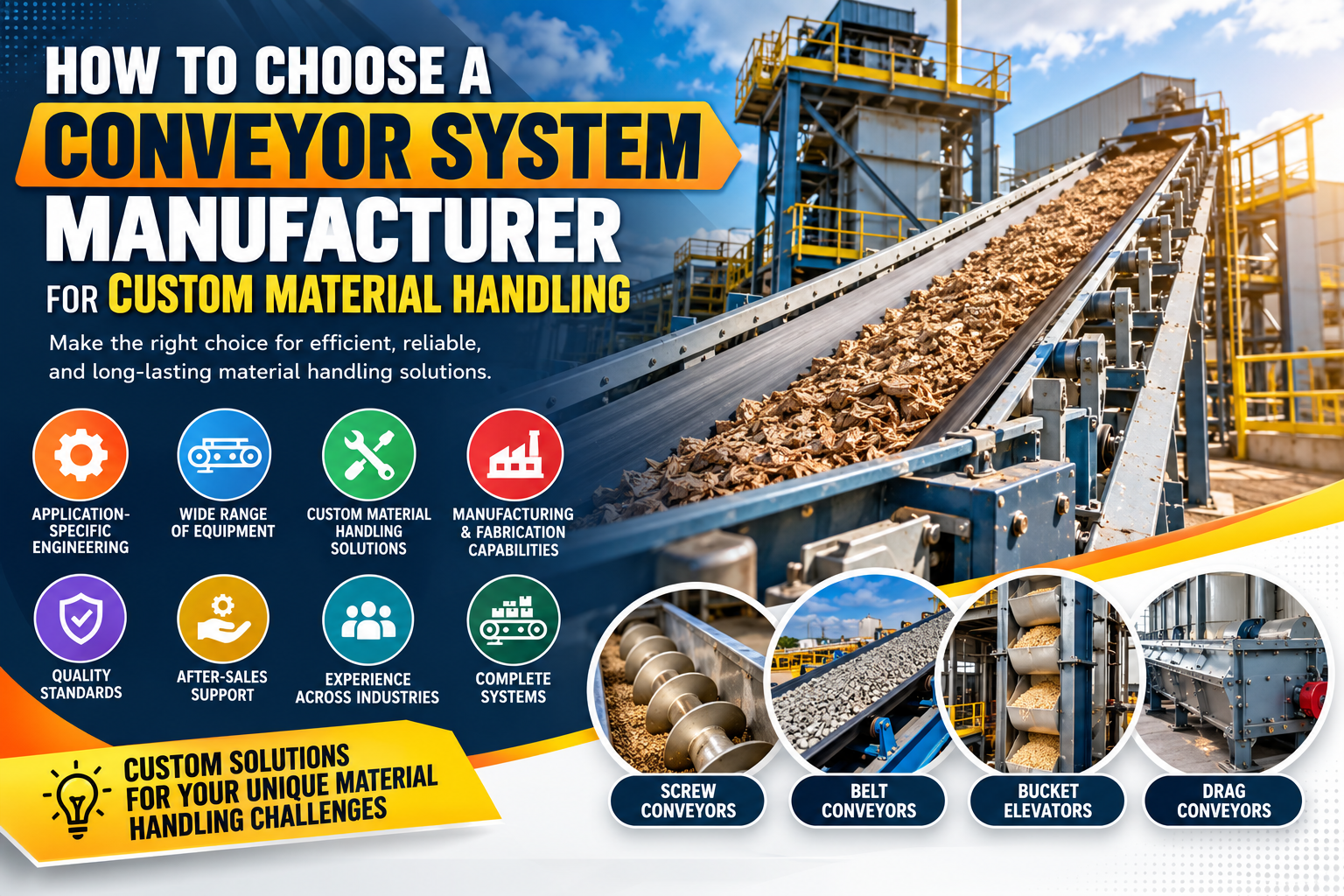
Your facility may use screw conveyors, belt conveyors, drag conveyors, bucketelevators, and other bulk material handling conveyors, so you should know what to look for.
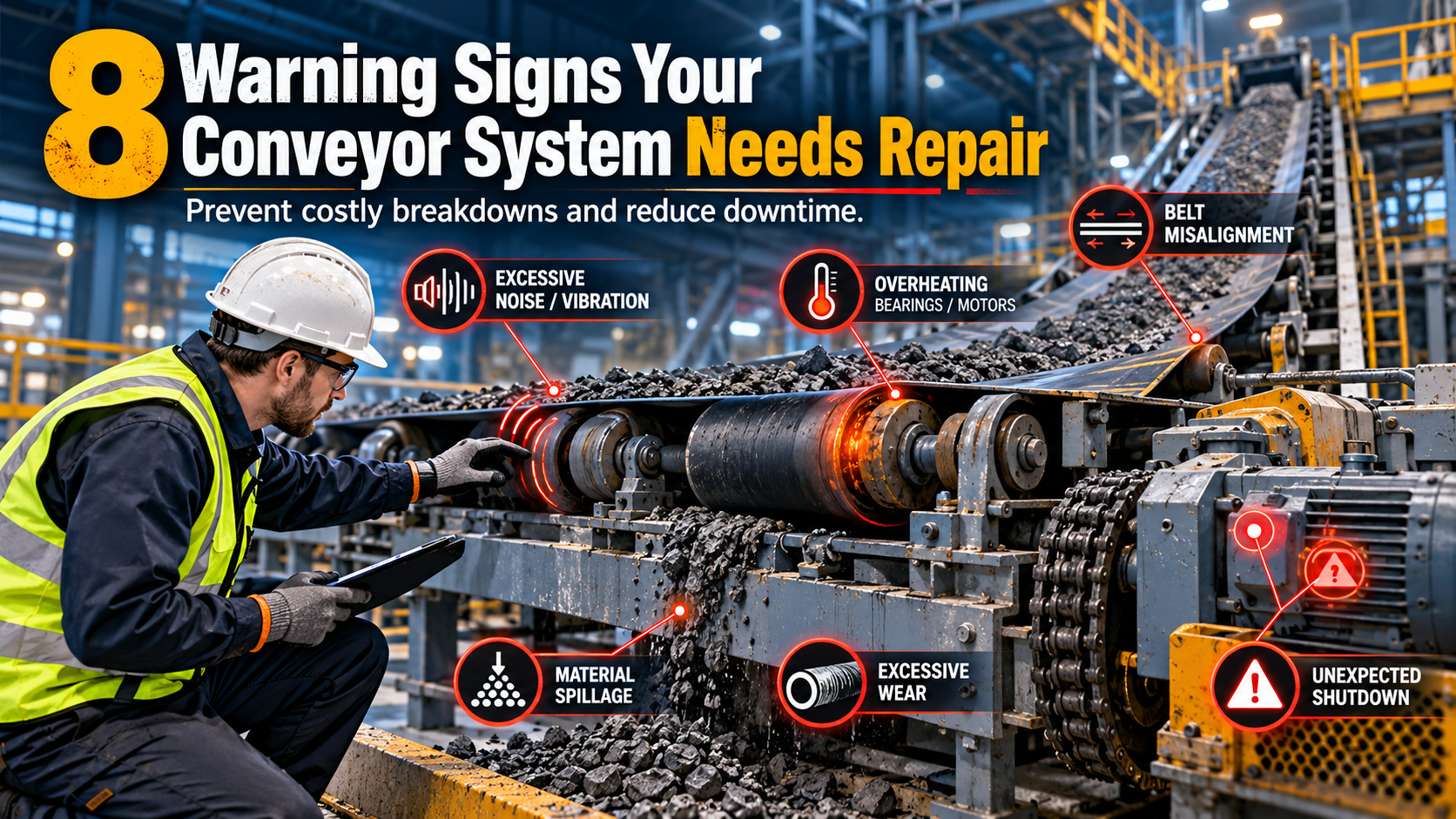
1. Unusual Noise or Vibration
Any alterations in the regular sound or motion of a conveyor system represent one of the most easily identifiable warning signals.
Squeaking, squealing, knocking, rattling, or increased vibrations could be an indication that there is a fault with the bearing, chain, sprocket, shaft, coupling, drive, or other equipment. When any conveyor becomes unusual in operation, it needs immediate examination.
Overlooking the sound can cause a small equipment problem to destroy the other system components. Early scheduling of Conveyor System Repairs can usually avoid further equipment damage.
2. Reduced Conveyor Performance
The problem of a conveyor that does not carry material as it should can stem from issues in the mechanics or operation of the equipment.
Decreased capacity can arise due to the wear of the machinery parts, incorrect installation, build-up, damage to flights and belts, driving issues, or changes like the material handled by the conveyor. Some conveyors might be working but at a lower level of efficiency than before.
It becomes possible to notice changes in performance when one tracks the normal performance of the conveyor.
3. Excessive Component Wear
The parts of a conveyor are prone to wear and tear, especially when the machinery is handling abrasive, heavy, corrosive, or non-flowing bulk materials.
Check areas like chains, sprockets, bearings, belts, flights, screws, liners, seals, and many other areas where there is potential for wear and tear. If the wear and tear is too much, it will ultimately impact the alignment of the conveyor.
Our Conveyor Maintenance Services can assist you in finding out which parts need replacement or repair before any breakdown occurs.
4. Frequent Belt Tracking Problems
For facilities using belt conveyors, continual belt misalignment must not be considered an insignificant problem.
The fact that the belt is moving to one side might be due to various issues related to alignment, pulleys, idlers, loading, among others. Operating in such a state will lead to wear on the belt and possibly other equipment.
Where adjustments have failed to solve the issue, then conveyor repair services would be required.
5. Material Spillage or Leakage
Unforeseen buildup of material near the conveyor may be indicative of some wear and tear or a problem in the system.
Spills not only make cleaning difficult but can also result in increased risk of falls or other accidents, contaminating the mechanical systems, and reducing the efficiency of the material handling system as well.
Inspection helps to determine the source of leaks and any adjustments or repairs required for the system.
6. Overheating Components
Heat buildup near any drive component such as bearings, motors, gearboxes, and others is another indicator that should not be overlooked.
Heat build-up may be linked to poor lubrication, overloading, misalignment, worn bearings, electrical problems, and resistance to mechanical movement. Running equipment in abnormal condition will result in failure of components faster.
Maintenance workers need to investigate any unusual heat rise and solve the problem rather than allow continued operation of equipment.
7. Increasing Maintenance Frequency
When the same conveyor needs to be repaired again and again, the problem may extend beyond a single faulty part.
Such a situation may indicate the misuse of the machinery, misalignment, poor maintenance, heavy loads, wrong parts, or even the end of the machine's working lifespan.
An expert analysis will make it clear whether Conveyor System Repairs should be pursued further, or component replacement or upgrade would be a more beneficial option.
8. Unexpected Shutdowns and Trips
Repeated motor start-ups, loads, or unplanned shutdowns should be considered.
This may not only disrupt the process but also signify that the conveyor is functioning in an unusual manner. This can further strain the drive, shaft, bearing, chain, and other conveyor parts.
Rather than resetting the equipment and starting it up again, one should try to find out why the problem occurred and arrange for corrective action.
Preventive Maintenance Can Reduce Unexpected Downtime
The ideal time for conducting repairs on the conveyor may be before it breaks down. Through proactive maintenance, you can spot equipment defects through inspections carried out when production is not happening.
Some examples of services that can be provided under Conveyor Maintenance include inspection, lubrication, component inspection, alignment check, wear evaluation, replacement of defective components, and other maintenance procedures.
Keeping maintenance records may also be important in helping to identify recurring issues. Documentation of repairs, replacement intervals of components, operating conditions, and performance of equipment may be important.
When to Call for Professional Conveyor Repair Services
Certain conveyor problems can be solved using maintenance, but more complicated mechanical failures may need professional intervention and the right replacement parts. Professional Conveyor Repair Services can assist you in finding the root cause of your conveyor problem and finding the best solution to it.
Conveyors Inc. offers conveyor systems, replacement parts, and solutions that can be used in bulk material handling applications. The company has the ability to design CEMA standard industrial conveyors, custom-made equipment, replacement parts, and full material handling systems.
If your problem is related to worn-out parts, equipment damage, efficiency problems, or you simply need replacement parts, it is better to solve your problem before it gets bigger.
Keep Your Conveyor System Running Reliably
Failure of conveyors hardly ever occurs without any prior indications. Any abnormal sound, vibration, low capacity, excessive wear, material leakage, overheating, recurring malfunctions, and frequent stoppages can be taken as signals that something needs to be done.
The
combination of routine checks together with professional Conveyor
Maintenance Services and Conveyor System Repairs can help prevent
serious malfunctions in the future.
Proactive maintenance of your equipment helps not only protect it from any damage but also can lead to safer and more productive material handling processes. If there are any signs of wear or malfunction on your conveyor, do not delay the check-up and find out what kind of Conveyor Maintenance or Repairs you need.